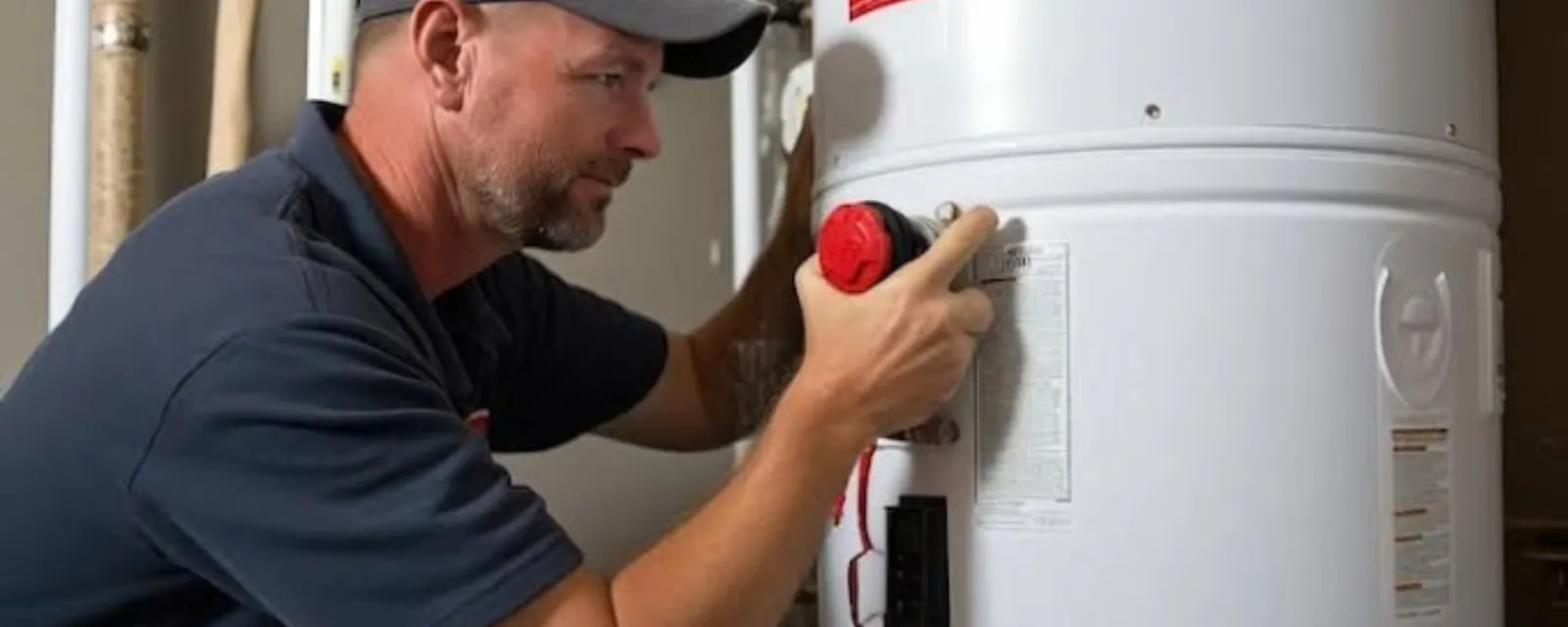
Leaking water heater: what to do first
If water is pooling under a tank water heater, act before you diagnose. Cut the energy source, stop the incoming water and keep people and belongings out of the wet area. A tank that is leaking from its base has usually failed internally, and a full tank can release dozens of gallons quickly.
- Electric heater: turn off the dedicated breaker. Gas heater: turn the gas control knob to pilot or off, or close the gas shutoff valve on the supply line.
- If you smell gas, leave the building, then call 911 or SDG&E from a safe place. Do not flip switches, use phones inside or do anything that can spark.
- Close the cold water supply valve on the pipe feeding the top of the heater. Turn the handle clockwise until it stops.
- Open one hot faucet upstairs to let pressure out of the system, which slows the leak.
- Move stored items off the floor, and mop or use towels to keep water away from walls and flooring.
- Call our 24/7 line at (619) 927-0312 to have a plumber assess whether repair or replacement is the right call.
How to tell where the water is really coming from
Not every puddle means a dead tank. Water can come from the top fittings and run down the outside, from the temperature and pressure relief valve discharge pipe, from the drain valve at the base, or from the tank shell itself. Dry the heater off with a towel, then watch for the first bead of water to appear.
If the water emerges from a fitting or valve, the repair may be small. If it seeps from the bottom seam or the jacket, the steel tank has typically corroded through, and the unit is at the end of its life. The table below lays out the usual suspects.
Where the leak is and what it means
| Where the water appears | Likely cause | Fixable? | What to do |
|---|---|---|---|
| Drips from the tube at the side of the tank into a pipe | Relief valve opening from high pressure or temperature, or a worn valve | Often, if the cause is high pressure or a worn valve | Have a plumber check pressure, thermal expansion and the valve itself |
| Wet connections on top where pipes meet the tank | Loose or corroded fittings or a failing supply connector | Usually yes | Shut off water and have the fitting repaired |
| Small drip from the drain valve at the bottom | Valve not fully closed or worn washer | Sometimes | Try closing it firmly, otherwise have it replaced |
| Water seeping through the base or jacket | Tank corrosion has breached the shell | No | Plan replacement, since a failed tank cannot be patched |
| Light dampness only during or after heavy use, evaporates quickly | Condensation from cool water meeting a warm tank or flue | Not a leak | Watch it, and call if it persists once the heater cycles normally |
Relief valve discharge versus tank failure
These two get confused constantly, and the answer changes whether you need a repair or a new heater.
Relief valve discharge
- Water comes out of the discharge pipe, not through the tank shell.
- It may be intermittent, often right after the burner or element fires.
- A plumber can test pressure and look for thermal expansion.
- The valve itself may simply be worn or stuck partly open.
- Often repairable without replacing the whole heater.
Tank failure
- Water appears at the base or seams and keeps coming after you shut off the supply.
- Rust-colored streaks or stains show on the jacket or the floor.
- The leak gets worse over days, not better.
- A corroded tank cannot be sealed.
- Replacement is the only reliable fix.
Draining the tank safely if the leak will not stop
Only do this once the power or gas is off and the cold supply is closed. A full tank is hot and heavy.
Let the water cool
Wait at least an hour if the heater was running. Water in a tank can scald seriously, and a drained stream can be just as hot.
Attach a hose
Connect a garden hose to the drain valve at the bottom and run the other end outdoors or to a floor drain that can take the volume.
Open a hot tap and the drain valve
Opening a hot faucet in the house lets air in so the tank can empty. Then open the drain valve slowly.
Watch for sediment
Gritty or rusty water confirms internal corrosion. Leave the heater empty until a plumber decides what comes next.
Why a bottom leak is rarely a quick patch
A steel tank is lined with glass, and an anode rod inside sacrificially corrodes to protect it. Once that protection is used up, the steel begins to rust from the inside and eventually pinholes. Epoxy, sealant or tape on the outside does not stop water pushing through from inside.
That is why most plumbers will advise replacement when the shell leaks, and repair when the leak is at a valve or fitting. Honest guidance is to confirm the source before you decide.
Safe to do yourself, and what to leave alone
- Shut off power or gas and close the cold water supply, since these steps prevent harm and are reversible.
- Dry the heater and surrounding floor so you can see where new water is coming from.
- Take photos of the leak area and the data label before anyone arrives.
- Do not relight a gas pilot or flip the breaker back on while the tank is wet or leaking.
- Do not cap, plug or remove the relief valve discharge pipe, which is a safety device.
- Do not try to weld, solder or patch a tank that leaks at the seam.
Repair or replace
A valve, fitting or connector problem is a job for water heater repair, and the heater can often keep serving the household afterward. A tank that has breached is a candidate for water heater replacement, and the plumber will go over capacity, fuel type and venting before you choose.
Age matters, but it is not the only measure. A heater well past its expected life that is leaking at a fitting may still call for replacement, because the next failure is likely not far off. A newer unit with a bad valve is a different case.
What affects the price of a water heater leak call
Costs fall into two buckets, repair of a part and replacement of the heater. Either way, the price is stated clearly before the work begins.
Part versus whole unit
A relief valve, drain valve or connector swap is a smaller job than replacing the whole tank.
Fuel type and venting
Gas heaters involve venting and gas connections. Electric units involve a dedicated circuit and a different set of checks.
Tank size and location
A larger tank or one in an attic, closet or garage with tight access takes longer to remove and install.
Code updates
Replacement may involve updated bracing, a drain pan, expansion control or a gas line change, depending on the existing setup.
Permit and inspection steps
Installing a water heater requires a permit, which adds paperwork even when the install is straightforward.
Sudden water damage from a failed tank is sometimes covered while the tank itself usually is not, so photograph everything and call your insurer before cleanup.
If you manage a property outside Coronado
The same shutdown steps work for any tank heater. Landlords with units across the bay can see how dispatch works on our plumber in Chula Vista page and our plumber in San Diego page.
Coronado note: bracing and the permit for a new heater
Earthquake strapping is a state requirement for replacement heaters and for existing home units up to 120 gallons (Health and Safety Code section 19211). So if your leaking heater is unbraced, the replacement must be strapped, and a plumber who installs it should include the bracing in the job rather than leaving it for later.
The City of Coronado Building Division's permit handout states that installing a water heater, including a tankless unit, requires a permit. It also notes that existing gas lines may need alteration, which requires gas line sizing calculations by a licensed plumber.
In plain terms, expect a permit when the leaking heater is swapped, and ask the Building Division about timing. A repair at a valve or fitting is a leak repair, which the handout lists as exempt, but permit rules vary for anything beyond that, so ask the Coronado Building Division.
Need a plumber now?
The 24/7 line is open for Coronado homes and businesses.
Questions about this topic in Coronado
Not always. Water that runs down from a top fitting, the relief valve line or the drain valve can look like a base leak. Dry the heater and watch where the first drop forms. Seepage through the shell means the tank has failed.
It is not advised. A leaking tank can fail suddenly, and an unattended gas or electric unit adds risk. Shut off the power or gas and the cold supply, then call for an assessment.
Yes. The City of Coronado Building Division's handout says installing a water heater, including tankless, needs a permit. Gas lines may need alterations with sizing calculations by a licensed plumber, and permit rules vary beyond that.
Yes. Health and Safety Code section 19211 requires new and replacement water heaters, plus existing residential units up to 120 gallons, to be braced, anchored or strapped against earthquake movement.
It can be, especially on a gas heater when the tank is first heating cool water, since moisture forms on the tank and flue. Condensation is light, dries quickly and does not keep growing. A steady drip or growing puddle is a leak.
Leave the building right away. From a safe place, call 911 or SDG&E. Do not use light switches, phones inside the house or anything that can spark, and do not go back in to turn the heater off.
Sources and standards behind this page
Every local rule or figure above comes from a published source, listed here so you can check it.
- City of Coronado Community Development, Building Division, Handout 301 (March 2025)
- California Health and Safety Code section 19211 (water heater earthquake bracing)