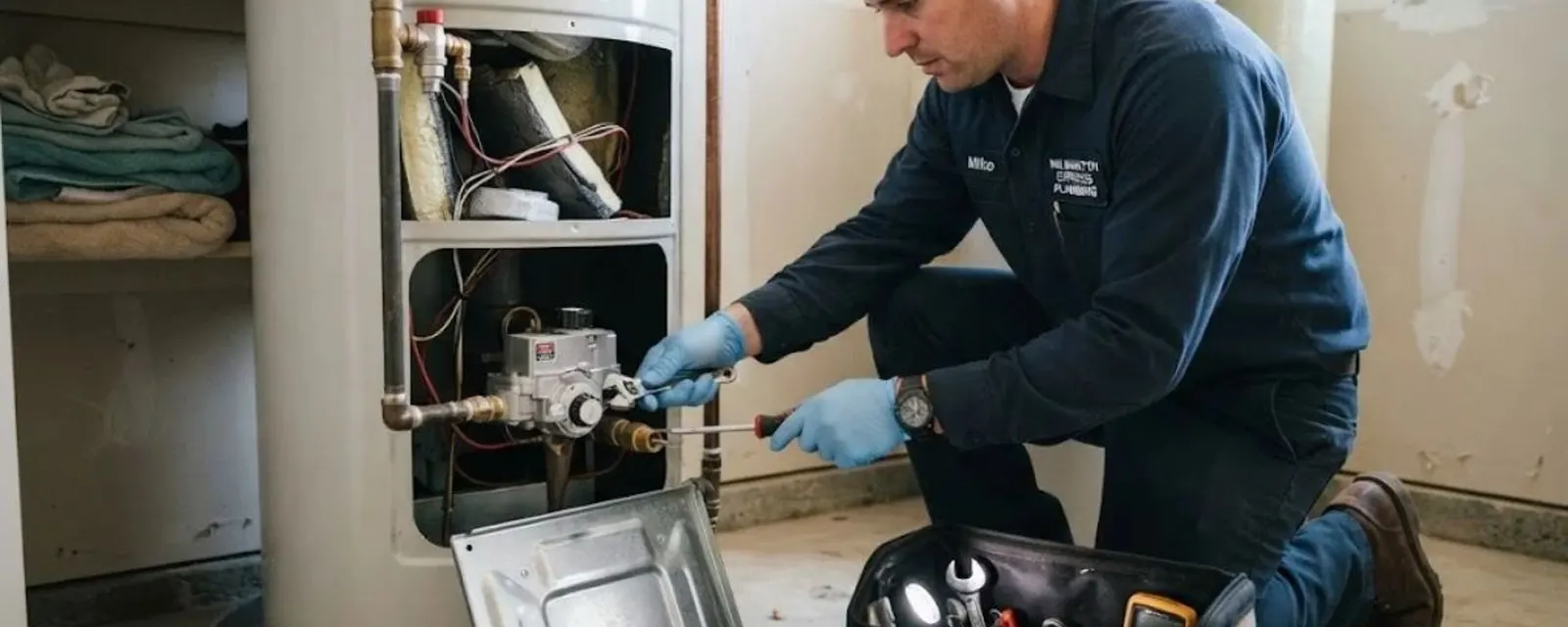
Water heater repair in Coronado, CA usually begins with water on the floor or a shower that never warms up, and both deserve a fast call. Our line runs 24/7. While you wait, close the cold supply valve above the tank and switch an electric unit off at its breaker. For a gas unit, set the gas control to off or pilot.
Water heater repair means finding out why a tank, element, burner or heat pump unit stopped heating or started leaking, then fixing the failed part. Some failures are quick and inexpensive. Others, like a tank leaking through its shell, cannot be repaired at all, and you will hear that plainly before any work starts.
Water heater leaking: emergency steps while you wait
A tank that drips from the bottom, pools under the unit or hisses near the relief valve can release dozens of gallons quickly. Do these things first, then call (619) 927-0312 and describe what you see.
- Turn off the power. Flip the breaker for an electric unit, or set a gas unit's control to off or pilot.
- Close the cold water shutoff on the pipe feeding the top of the tank. A lever handle sits across the pipe when it is closed.
- Move boxes and electronics away from the heater, and lay towels or run a wet vac along the path the water takes toward a drain.
- Stay clear of the relief valve discharge pipe, because water leaving it can be scalding hot.
- If you smell gas, leave the building first, then from a safe place call 911 or SDG&E. Do not use switches or phones inside.
- Photograph the data plate on the tank and every wet spot, since both help the plumber arrive with the right parts.
Where a leaking tank is really leaking from
Not every wet spot means a dead tank. Water near the top often comes from a loose fitting, a weeping flexible connector or a dripping inlet valve, and those are repairs. Water at the relief valve can mean the valve itself failed, or that pressure or temperature inside the tank climbed too high.
Water from the bottom brings the hardest news. A drain valve that drips is a cheap fix. A puddle that keeps growing while every fitting stays dry usually means the inner steel tank has corroded through, and a tank in that condition cannot be patched safely. The answer is replacing the unit, and that page explains how the visit works.
Condensation can fool you too. A cold tank in a humid room can sweat enough to look like a slow leak. A plumber dries every fitting, wraps dry tissue around each one and watches for fresh wetness. If water has already reached a wall or floor, adding a leak detection check shows whether any other pipe is involved.
Tank leaking or water cold?
Call (619) 927-0312 at any hour. Same-day appointments when available.
No hot water: electric, gas and tank causes
A cold shower becomes urgent in winter, with a baby or an older relative at home, or when the tank is also wet. Same-day and after-hours calls are what the dispatch line is for. On an electric unit the usual causes are a tripped breaker, a tripped high-limit reset button, a failed heating element or a bad thermostat. On gas, check whether the pilot is lit and the gas valve is open.
Warm but never hot water points to a failed lower element, a burner chamber coated with soot or a broken dip tube that lets cold water mix at the top of the tank. If a breaker trips twice, stop resetting it. Repeated tripping signals a short or a bad element, and forcing it back on is a fire risk.
Repair or replace: a decision table
A plumber decides with three facts: where the water is, how old the unit is, and whether the failed part costs little next to a new tank. Use the table as a starting point and let the visit confirm it.
| What is found | Usually repair | Usually replace |
|---|---|---|
| Dripping drain valve or loose fitting | Yes, a part swap and a tightened connection | Only if the tank is already at the end of its life |
| Failed element, thermostat or thermocouple | Yes, the part is small compared with the tank | Rarely, unless the tank is old and heavily scaled |
| Water pooling beneath a tank with dry fittings | No, the inner tank has usually failed | Yes, and soon |
| Rusty hot water from only the hot taps | Sometimes, if the tank is sound and the anode rod is spent | Yes, when the rust comes from a corroded tank interior |
| Loud popping or rumbling while heating | Often, a flush clears loose sediment | If hardened scale has caused leaks at the base |
| A tank past its typical service life with repeated repairs | Only for a small one-off fix | Usually, because the next failure is close behind |
Electric, gas and hybrid units: what actually gets fixed
Electric tank heaters have the shortest repair list. They carry two heating elements, two thermostats, a high-limit switch and a relief valve. A meter test shows which part failed in minutes, and elements and thermostats are routine swaps.
Gas units add a burner assembly, a pilot or electronic igniter, a thermocouple or flame sensor, a gas control valve and a vent. A pilot that keeps going out, a sooty burner or a flue that does not draw needs careful attention because carbon monoxide is a real risk. Any suspected exhaust problem means turning the unit off and calling.
Heat pump water heaters, often sold as hybrid units, pull heat from the surrounding air with a compressor and fall back on electric elements. A plumber can work on the element and thermostat side, the condensate drain, the air filter and the error codes. Compressor and sealed-system faults usually belong to the manufacturer's service network, and you will be told honestly when a repair falls outside plumbing.
A hybrid unit also needs room to breathe. If the space is tight, the filter is clogged or the drain is blocked, it may quietly run on its elements and push up the power bill without any alarm.
Earthquake straps and hard water in Coronado tanks
State law, Health and Safety Code section 19211, makes earthquake bracing part of any new or replacement tank, and it covers existing home heaters up to 120 gallons too. On a repair call that means loose or missing straps are worth fixing while the plumber is already at the tank, since a toppled heater breaks gas and water lines.
The water itself is the second wear factor. Cal Am's 2023 report on its Coronado supply puts the treated water at 8.5 to 16.4 grains per gallon, hard to very hard. Dissolved minerals at that level settle as scale on the tank floor and around elements.
Scale insulates the water from the burner or element, so you hear rumbling, wait longer for hot water and see earlier failures. A drain and flush each year is a sensible habit. If you want to treat the cause, the softener and filtration page explains sizing from hardness.
How a repair visit runs
Call any hour and describe it
Tell dispatch the fuel type, the brand if you know it and where the water or cold shows up. A photo of the data plate speeds up parts planning.
Diagnose before parts
The plumber tests power or gas, checks the relief valve and every fitting, and looks at the tank base for scale and rust.
Hear the price first
You get a clear price for the repair or the swap before work starts. If a repair makes no sense, you are told so instead of getting a patch on a failing tank.
Test and explain
The plumber restores power or gas, brings the tank to temperature, rechecks for leaks and straps, and explains what maintenance the unit needs.
What shapes the price of a water heater repair
The price depends on what failed and the work around it, not on a flat rate. You get a clear price before work starts, and no dollar figures appear here because the diagnosis comes first.
Which part failed
A thermostat or element is a small job. A gas control valve or a leaking drain port on an old tank is bigger.
Fuel type and venting
Gas units add vent and combustion checks that electric units skip, and that adds time.
Where the tank sits
A garage or closet with room to work is quick. An attic or a tight utility cabinet takes longer to reach.
Age and condition
A heavily scaled or rusted tank may be a poor candidate for new parts.
Parts availability
Common elements and thermostats are easy to find. Older or specialty models may need a part ordered.
Some homeowners policies cover sudden water damage from a failed heater but not the heater itself or slow leaks. Photograph the damage before cleanup and ask your insurer, because we cannot promise coverage.
Habits that prevent the next call
- Drain a few gallons from the tank drain valve every six months so loose sediment leaves before it hardens.
- Lift the relief valve lever once a year with a bucket under the discharge pipe, and call if it will not reseat.
- Keep the thermostat near 120 degrees Fahrenheit to reduce scale and scalding risk.
- Look at the straps every year and check that the tank does not rock when pushed.
- Ask a plumber to inspect the anode rod once the tank passes the five year mark.
Water Heater Repair questions in Coronado
It depends on the source. Leaks from a fitting, valve or connector are repairable. Water seeping from the bottom of a tank with dry fittings usually means the inner tank failed, and that unit needs replacement.
Yes. Dispatch runs 24/7, including nights, weekends and holidays, so a leaking tank at 2 a.m. gets the same call-taking as one at noon. Same-day appointments are offered when available, and no arrival time is promised. While you wait, shut off power or gas and close the cold supply valve.
The sound is usually scale. Cal Am water in Coronado is hard to very hard, and minerals settle on the tank floor, trap steam bubbles and pop. A flush often helps unless the scale has hardened.
Yes, though the rule is statewide. The state's strapping law, Health and Safety Code 19211, covers new and replacement units and every existing residential heater up to 120 gallons. A plumber can check your straps during any repair visit.
Fixing leaks in pipes, valves or fixtures is exempt in the city's permit handout, while putting in a water heater is not. Your case may differ, so confirm with the Building Division on (619) 522-7331.
Common causes are a failed lower element, a broken dip tube or a tank full of sediment that takes up volume. A plumber can tell which by testing power, checking the tube and flushing the tank.
Often yes for elements, thermostats, filters, condensate drains and error codes. Compressor or refrigerant faults usually need the manufacturer's service network, and you will be told if your problem falls in that group.
Yes. Look up any California plumber at cslb.ca.gov, the Contractors State License Board site. Plumbing falls under licence class C-36, so search for that class before you hand over a deposit.
Yes, we serve Coronado and nearby towns. If your tank is across the bay or down the Silver Strand, see our pages for Chula Vista and downtown San Diego.
Sources and standards behind this page
Every local rule or figure above comes from a published source, listed here so you can check it.
- City of Coronado Community Development, Building Division, Handout 301 (March 2025)
- California Health and Safety Code section 19211 (water heater earthquake bracing)
- California American Water, Coronado system 2023 annual water quality report
- Contractors State License Board, cslb.ca.gov (plumbing is license class C-36)