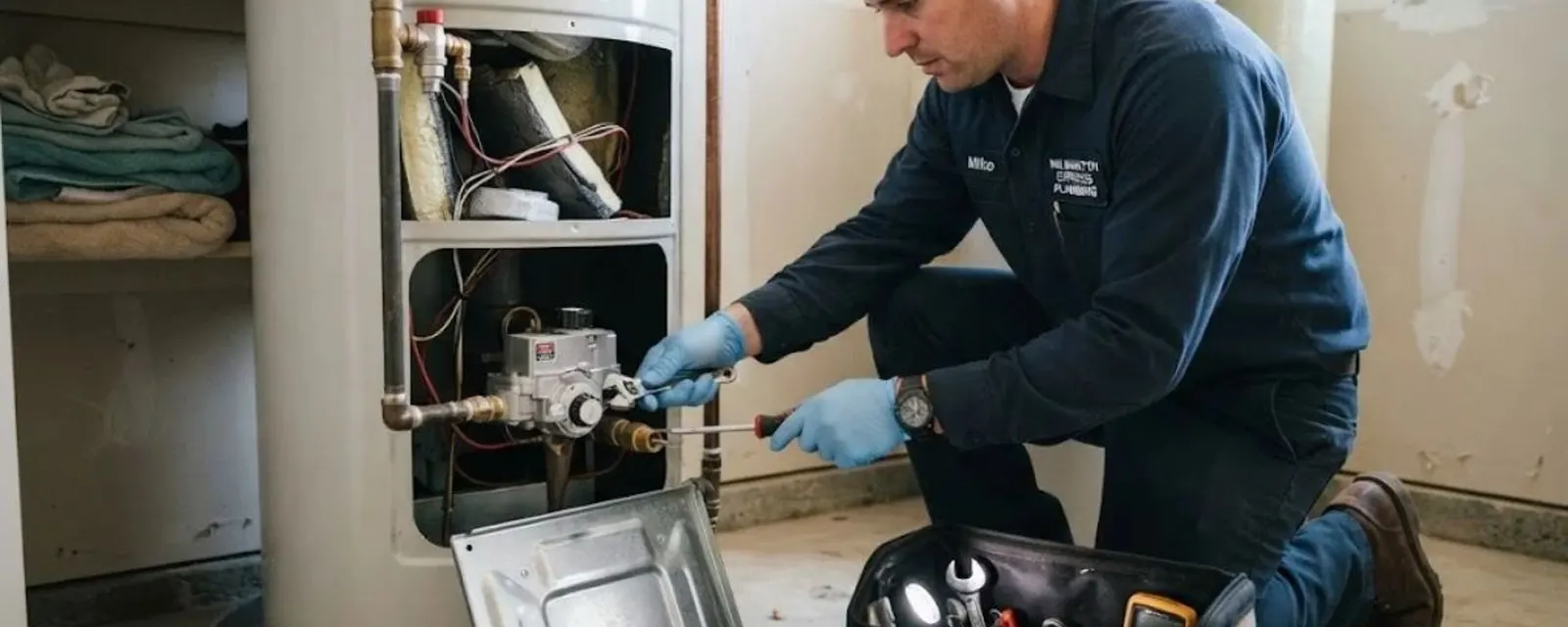
Safety first: this is a power job, not a plumbing job
An electric water heater runs on household power at a level that can seriously hurt you. Before any cover comes off, switch the heater's breaker off at the panel, then confirm with a tester that no power reaches the wires. A breaker label can be wrong, and a tester is the only proof.
This guide covers electric tank heaters only. A gas water heater has a gas control valve, and that is never a homeowner repair. If you smell gas, get everyone outside and phone SDG&E or 911 once you are clear of the building.
How the thermostats decide whether you have hot water
Most electric tank heaters have an upper and a lower thermostat, each switching its own heating element. The upper one heats the top of the tank first, then hands off to the lower one. Above the upper thermostat there is usually a red reset button, the high-limit cutoff that trips if the water gets too hot.
A bad thermostat can give you no hot water, lukewarm water, water that runs hot and cold in cycles, or water so hot it is unsafe. Because elements fail with the same symptoms, you test before you replace.
What the symptom usually means
| Symptom | Likely cause | First check |
|---|---|---|
| No hot water at all | Tripped breaker, tripped reset button or failed upper thermostat | Breaker, then the reset button, then the upper thermostat |
| Hot water runs out quickly | Failed lower thermostat or lower element | Test the lower thermostat and element |
| Water too hot | Thermostat set too high or stuck closed | Check the setting, then test the thermostat |
| Reset button keeps tripping | Short in an element or a failing thermostat | Call a plumber if it trips again after a reset |
| Breaker trips repeatedly | Grounded element or wiring fault | Stop and call a licensed professional |
Replacing a thermostat the careful way
Always follow the manufacturer's instructions for your model, because thermostat styles and wiring layouts differ.
Cut power and prove it
Turn off the breaker, remove the access panel and insulation, and use a non-contact voltage tester or meter on the terminals to confirm no power.
Photograph the wiring
Take clear pictures of every wire before disconnecting anything. Label the wires with tape if the manual suggests it.
Test the old thermostat and the element
With the wires off, use a multimeter as the manual directs. Test the element too, since a bad element can look like a bad thermostat.
Install an exact match
Use the same type and rating as the original. Make sure the thermostat sits flat against the tank wall, because it senses tank temperature by contact.
Close up, then restore power in order
Reconnect wires per your photos, replace insulation and covers, refill the tank fully if it was drained, and only then turn the breaker back on.
What a homeowner can handle and what to hand off
Reasonable for a careful DIYer
- Checking the breaker and pressing the reset button once.
- Lowering a thermostat setting if the water is too hot.
- Replacing a thermostat with an exact match when the power is proven off and the wiring is photographed.
- Draining a few gallons to look at the sediment that comes out.
Leave to a licensed plumber
- Any gas control valve, burner or pilot work on a gas heater.
- Elements that will not come out, or a tank that leaks.
- Repeated breaker trips or a reset button that trips again and again.
- Scorched wires, melted insulation or any burning smell.
Why elements and thermostats tend to fail around the same time
Elements work by heating the water around them, and a coating of scale acts like a blanket that traps heat against the metal. The element runs hotter, wears faster and can trip the high-limit switch. That is why a thermostat swap sometimes fixes nothing, because the element was the part under strain.
If you do replace an element, use the manufacturer's element wrench and thread seal guidance, and drain the tank first. Never power the heater until the tank is completely full and you have let air out of a hot tap. A dry element can burn out in moments, and that damage is permanent.
Mistakes that turn a small repair into a big one
Trusting the breaker label
Panels are mislabeled more often than people think. Test the terminals before touching them.
Heating an empty tank
Elements burn out within minutes when they are not covered by water. Fill the tank before restoring power if you drained it.
Buying a non-matching part
Voltage, wattage and thermostat style must match the heater's label.
Loose thermostat contact
A thermostat that does not touch the tank wall reads the wrong temperature and can overheat the water.
Skipping the reset button check
A tripped high-limit can look like a dead heater. Pressing it once is free, but if it trips again, find out why.
What shapes the cost of a thermostat repair
The thermostat itself is a small part. Most of what you pay for is diagnosis, safe access and what else turns up.
Which parts failed
A single thermostat is quick. A thermostat plus a burnt element takes longer and may need draining.
Age and condition of the heater
On an older tank with a corroded base, spending on parts may not make sense compared with replacement.
Sediment and element access
Scale locked around elements can make them hard to remove and sometimes damages threads.
Wiring condition
Brittle or scorched wires need repair or replacement before a new thermostat can be trusted.
Code items nearby
A heater found without proper bracing or other required items may need those corrected as part of the work.
Insurance usually will not pay for a worn thermostat, but a sudden tank leak and the water damage it causes may be covered, so photograph the damage and ask your carrier.
Before you open the access panel
- Read the label on the heater for voltage and wattage and write both down for the parts counter.
- Switch off the breaker, then test the terminals with a tester you have confirmed works.
- Keep your phone nearby and a flashlight on, so you can photograph wiring without moving your hands near terminals.
- Make sure the floor is dry and you are not standing in water.
- Have a plan for water if you drain the tank, such as a hose to a safe drain outside.
- Decide in advance that any burnt smell, melted plastic or tripping breaker means you stop and call.
Repair or replace: a quick way to decide
If the heater is newer, not leaking and only needs a thermostat or element, repair is almost always the better value. If the tank is leaking from the bottom or sides, no thermostat will help, and you are shopping for a new heater.
Our water heater repair page lists what we look at on an electric tank, and when the tank has reached the end of its life, water heater replacement covers what comes next. We also dispatch to Chula Vista and San Diego, where the same electric tank wiring applies.
Coronado note: bracing law and hard water sediment
Under Health and Safety Code section 19211, a home water heater of up to 120 gallons has to be braced, anchored or strapped against earthquake movement, and so does every new or replacement unit. If you open the heater for a thermostat swap, look at the straps while you are there. A heater without them is out of step with state law, and a tank that shifts can tear its own wiring and pipes.
Hardness is the second local issue. Cal Am's 2023 water quality report for its Coronado system gives a range of 8.5 to 16.4 grains per gallon, from 145 to 280 ppm. Water that hard leaves scale on the bottom of the tank and around the elements. That is why a heater here can have sediment trouble that looks like a thermostat problem, and why a short drain to check the sediment is a useful part of any diagnosis.
Need a plumber now?
The 24/7 line is open for Coronado homes and businesses.
Questions about this topic in Coronado
Yes. California Health and Safety Code section 19211 requires new and replacement water heaters, and existing residential heaters up to 120 gallons, to be braced, anchored or strapped against earthquake movement. If your tank has no straps, add them or have a plumber do it.
Test both with a multimeter after power is off and the wires are disconnected, following your manual. A failed element and a failed thermostat can look alike from the outside. Testing first prevents buying a part you do not need.
It is the high-limit cutoff, a safety switch that trips when the water gets too hot. Press it once after switching the breaker off, then restore power. If it trips again, something is wrong with a thermostat or element and you should call a plumber.
No. A gas heater's temperature is managed by its gas control valve, and that is licensed work because a mistake can cause a gas leak. A gas smell means everyone goes outside first, and the call to SDG&E or 911 is made from a safe distance.
A thermostat can stick closed or lose contact with the tank wall, so it keeps heating past the setpoint. Scalding water is a safety issue. Turn the setting down and the breaker off, then have the thermostat tested.
A leaking tank, rusty water that persists after the heater is flushed, and repeated element failures are common signs. Age matters too, and the label on the tank often includes a date code you can look up with the manufacturer.
Sources and standards behind this page
Every local rule or figure above comes from a published source, listed here so you can check it.
- California Health and Safety Code section 19211 (water heater earthquake bracing)
- California American Water, Coronado system 2023 annual water quality report