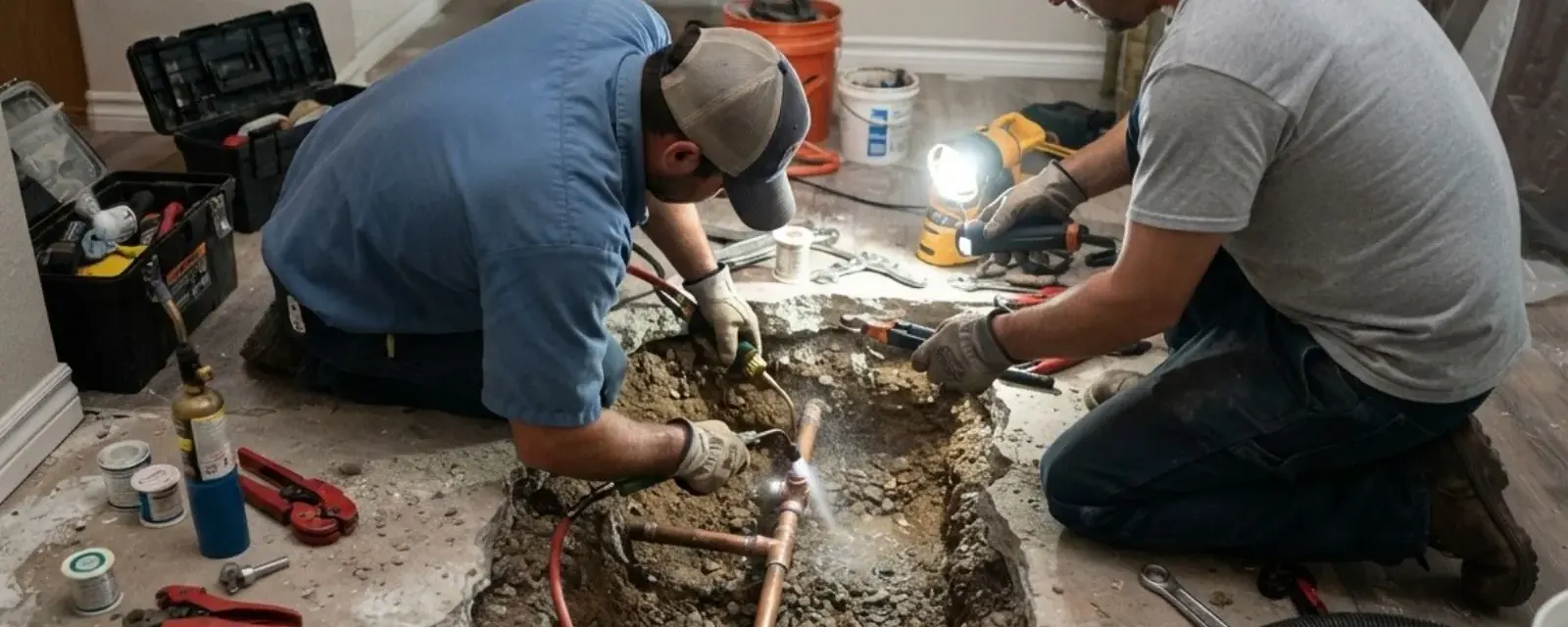
A slab leak is a break in a pressurized water pipe that runs under or inside a concrete floor, and it can start flooding a home from the floor up. Slab leak repair in Coronado, CA starts with confirming that the leak really is below the floor, because several cheaper problems look alike. Dispatch is open 24/7. Until a plumber arrives, close the house main valve and keep the area dry.
This page covers the warning signs, how a leak under concrete is located without tearing up the whole house, and the four real repair paths with the trade-offs of each. We do not assume that any particular Coronado home sits on a slab, so the first visit confirms the foundation type and the pipe layout before any plan is made.
Signs the leak may be under the floor
No single sign proves a slab leak. Two or more together make it likely enough to book a diagnosis.
A warm patch on the floor
A leaking hot water line heats the concrete above it. Bare feet find it before any instrument does.
The meter moves with everything off
If the meter keeps turning after you close the house main, the loss is outside. If it stops, the leak is inside the home, which includes under the floor.
A sudden high water bill
A pressurized leak runs around the clock, so the bill climbs month after month without any change in how you live.
Hissing or running water sounds
At night, with the house quiet, a steady hiss from a floor or wall can be a pressurized pipe under the house.
Damp carpet or lifting flooring
Water finds its way up through cracks and joints, so baseboards swell, carpet feels cool or wet and floor planks start to cup.
Weak hot water or low pressure
A leak on the hot line can drain the water heater faster than normal and reduce what reaches the faucets.
Ruling out the cheaper explanations first
Before recommending any work under a floor, a plumber checks the easy suspects. A leaking toilet fill valve, a dripping water heater relief valve or a running irrigation line can all move the meter and raise the bill. A warm floor can also come from a heating system or sun through a window.
The usual order is to run a meter test, close the house main, then isolate the hot and cold lines one at a time with pressure gauges. If the hot side loses pressure and the cold side holds, the search narrows quickly. Only then does the plumber bring in listening equipment and thermal imaging to find the spot on the floor.
Skipping this step is how homeowners end up paying for concrete cutting when the problem was a fitting at the water heater. Ask for the findings in plain words before you approve any demolition.
Floor warm, wet or noisy?
Call (619) 927-0312 and a plumber can be dispatched for same-day diagnosis when available.
Four ways to fix a pipe under a slab
The right choice depends on where the leak is, how old the pipe looks and how much of the house you can live without while work happens.
| Repair option | What happens | Main trade-off |
|---|---|---|
| Spot repair | The floor is opened above the leak, the damaged section is cut out and a new piece is joined in | Fastest and least disruptive, but other weak points in the same pipe can leak later |
| Reroute | The failed line is abandoned and a new one runs through walls or the attic to the same fixtures | Avoids more concrete work, but requires access through finished walls and ceilings |
| Repipe | Most or all supply lines are replaced with new pipe | Deals with repeated failures, but is the largest job and needs patching afterward |
| Epoxy lining | A coating is applied inside the existing pipe to seal pinholes and thin spots | Avoids digging, but depends on the pipe condition and does not suit every fitting or damaged section |
Choosing between a spot fix and something bigger
A single failure in an otherwise sound pipe is the best case for a spot repair. The plumber cuts the floor open directly over the pinpointed leak, replaces a short section and closes it back up. The weakness is that pipe material that failed once in one place may be wearing everywhere, so ask what the exposed pipe looks like.
A reroute makes sense when the leaking line is hard to reach or has failed more than once. New piping goes overhead or through walls, which costs access work but avoids a trench through the floor. Repiping is worth discussing when leaks keep reappearing, and our repiping page explains how that job works.
Epoxy lining suits some copper lines that are thin but not split. It works poorly on badly damaged pipe and does not fix a failed joint, so a plumber should camera inspect and pressure test before suggesting it.
Water coming up through the floor is an emergency
Water on the floor with no obvious source, or a floor that suddenly feels hot and wet, can cause serious damage in hours. Slab leak calls are answered at any hour, and if a plumber has an opening today the visit can happen today. Nothing is promised on timing, so work through the list below.
- Close the main shutoff valve at the house by turning it clockwise until it stops. This usually slows or stops a leak on the supply side.
- If water is spreading toward outlets or appliances, turn off power only if you can reach the panel dry. Otherwise stay back and tell the dispatcher.
- Shut off the water heater's gas or power and its cold water inlet if the leak is on the hot side. This protects the heater from running dry.
- Lift rugs, move furniture and photograph wet areas, the meter and any stained baseboards for your insurance record.
- Do not drill, saw or hammer on the floor to chase the leak. A cut into concrete can hit other pipes or electrical conduit.
Permits, and what Coronado's water has to do with pipe wear
Coronado's permit handout requires a permit for replacing piping below the floor, while repairing a leak in a pipe is exempt. That distinction matters for slab work. A spot repair of a leaking pipe may qualify as exempt, but a reroute or repipe usually counts as replacement, so a permit is part of the plan. Check your scope with the Building Division before work starts.
Cal Am's 2023 report for the Coronado system puts pH at 7.9 to 8.2 and hardness at 145 to 280 ppm as calcium carbonate. Those numbers are general context for how mineral-rich water behaves in plumbing over many years, and they do not prove why any single pipe failed. A plumber judges the cause from the pipe itself.
What a slab leak visit looks like
Knowing the sequence helps you judge whether the diagnosis is solid before you spend money on repairs.
Confirm and isolate
The plumber reads the meter, closes the main and pressure tests the hot and cold lines separately to see which one is losing pressure.
Pinpoint the spot
Acoustic listening and thermal imaging narrow the leak to a small area on the floor, down to a small area.
Explain the options
You see the findings, the repair choices and the permit position, with a clear price before work starts.
Repair and test
The new section or route is installed, pressure tested and checked for leaks before anything is covered.
Close up and dry out
The opening is closed. Flooring, baseboards and drywall that got wet may need drying or separate finish work.
High bills and the leak you cannot see
A slab leak is a prime reason for a bill that rises with no visible cause, because water leaks all day and night through a pinhole at full line pressure. If the bill has risen, our leak detection page explains the meter test and the other places water can escape.
A slow leak under a floor can go unseen for months. If water is bubbling up in the street, that is a job for the utility's own emergency number, 1-888-237-1333. For everything on your side of the meter, call us.
Our plumbers also work in Chula Vista and San Diego, where the water utility can differ, so we ask about the address at the start of the call.
What drives the cost of a slab leak repair
Quotes for work under a floor vary a lot, and you get a clear price before work starts. These are the factors that move the number.
Which repair path you choose
A spot repair, a reroute, a repipe and epoxy lining involve very different amounts of labor and material.
Leak depth and location
A leak under a kitchen cabinet or tile floor is harder to reach than one in an open room.
Flooring to remove and replace
Tile, hardwood and carpet each need different handling, and the patch back to a matching finish is often separate from plumbing.
Permit and inspection steps
Reroutes and repipes involve permit work, which adds coordination time that a simple leak repair does not.
Pipe age and condition
If the exposed pipe is thin or pitted, a plumber may recommend replacing more than the leaking section.
Some homeowner policies cover water damage from a sudden leak and the access needed to reach it, but not the pipe itself. Call your insurer early, keep your photos and ask the plumber for a written description of the cause and location.
Slab Leak Repair questions in Coronado
Look for a warm floor spot, a meter that keeps running with everything off, a bill that jumps without explanation or the sound of water at night. One sign is not proof. A plumber confirms with pressure tests and listening gear before any floor is opened.
Yes. Yes. Calls are answered overnight and through weekends. If a plumber has an opening, diagnosis can be the same day, but no arrival time is promised. Close the main valve, keep water away from outlets and photograph the damage while you wait.
We do not state that for Coronado as a whole. Foundation types vary from house to house, so a plumber confirms whether yours has a slab, a raised floor or a mix before recommending anything for a leak under the floor.
Not always. A heated floor system, strong sun through windows or a nearby hot duct can warm a surface. A warm spot that sits in one place, plus a hot side that loses pressure or a running meter, points more strongly to a leaking hot line.
Repairing a leak in a pipe is exempt under the city handout, but replacing piping below the floor needs a permit. A spot fix and a reroute can land on different sides of that line, so the Building Division at (619) 522-7331 is the place to confirm.
It can seal pinholes in some copper lines without cutting the floor. It does not suit severely damaged pipe, split joints or every fitting. A camera inspection and pressure test decide whether lining is realistic or a short-term patch.
Close the main valve while you wait if the leak is active. You can open it briefly for essentials, but each time the line is pressurized the leak resumes. Your plumber may isolate the damaged line so the rest of the house can stay in service.
Once the leaking pipe is sealed, the extra use from that leak stops, and the next billing cycle should reflect it. If the bill stays high, other leaks or higher use may be involved, so a follow-up meter test is a sensible check.
Sources and standards behind this page
Every local rule or figure above comes from a published source, listed here so you can check it.
- City of Coronado Community Development, Building Division, Handout 301 (March 2025)
- California American Water, Coronado system 2023 annual water quality report