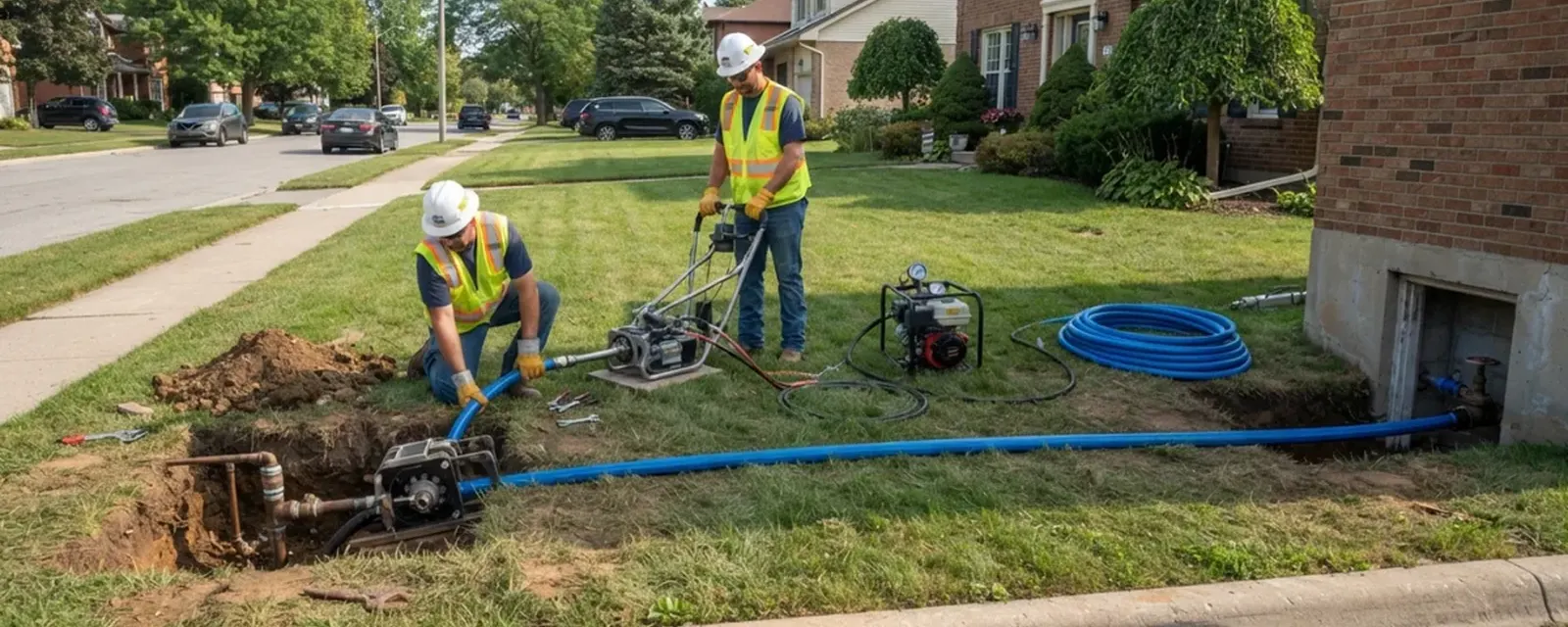
The water service line is the buried pipe that carries water from the meter area to the house, and when it leaks, you lose pressure, money and sometimes a patch of yard. Water line repair in Coronado, CA covers locating the break, deciding between a spot repair and replacement, and restoring flow. Our line runs 24/7. If water is surfacing, close the house main and call.
Most service line problems announce themselves in three ways: a meter that runs with the house shut off, pressure that is weaker than it used to be, or a wet strip of ground with no rain or irrigation to explain it. This page walks through each symptom, the repair methods that avoid trenching your whole yard, and the questions to ask before agreeing to a replacement.
Signs the service line is leaking
These signs are worth checking in this order, since they separate a buried-line problem from an indoor one.
Meter moves with the main closed
Close the valve at the house and watch the meter. If it still turns, the loss is on the buried pipe between the meter and the house.
Wet or sunken ground
A soft patch, a green stripe in dry weather or a depression along the pipe route can mean water is escaping underground.
Pressure that fades
A growing leak steals pressure, so showers weaken and a hose slows to a trickle.
The sound of running water
With everything off, a hiss near the meter box or entry point suggests water moving where it should not.
Cloudy or dirty water
A break lets soil and debris in when pressure drops, which can show as discolored water at the tap.
Finding a leak that you cannot see
A buried leak does not always surface. Water can drain into loose soil, gravel or a storm drain and leave almost no visible trace. Cal Am's customer guidance acknowledges that many leaks go unnoticed while still adding to water use, so the meter, not the yard, is often the best clue.
A plumber confirms the leak with a meter test and a pressure test on the line, then traces the pipe route and listens along it for the sound of escaping water. If the pipe is plastic and quiet, tracer gas can find the spot. The aim is a single small excavation instead of a long trench.
Our leak detection page explains these methods in more depth and also covers meter-running and high-bill tests.
Suspect a leak in the line?
Call (619) 927-0312 any time. Same-day visits are possible when the schedule allows.
Leaking service line: what to do right away
A water line leak can undermine soil, soak a foundation edge and drive up a bill by the hour. Calls come in around the clock. If a plumber is free, the visit can be the same day, but no timing is promised, so take these steps in the meantime.
- Close the main valve at the house. If water continues to flow in the yard after you do, the break may be upstream of the valve, so phone the utility at 1-888-237-1333.
- Keep people, pets and vehicles away from soft or sinking ground. Saturated soil can give way under weight.
- Photograph the wet area, the meter and any damage to paving or landscaping before the plumber digs.
- Do not dig around the pipe yourself. Other buried lines, including electrical and gas, may run close by.
- Check for water entering the house through a garage, crawl area or foundation edge, and move stored items off the floor.
Low water pressure: line, valve or fixture
Low pressure has several causes, and a leaking service line is only one of them. The question to ask first is whether the weakness is everywhere or at one fixture. A single clogged aerator, a partly closed valve or a worn cartridge affects one tap, while house-wide weakness points to the main valve, a pressure regulator or the line itself.
A plumber typically starts with a gauge on a hose bib to read static and running pressure. A reading that drops sharply when water flows suggests a restriction or a leak. Then the main valve, the regulator if there is one, and the service line are checked in turn.
Mineral buildup inside older pipe can also choke flow. Total hardness of the treated supply, 145 to 280 ppm in the 2023 report, rates hard to very hard on the USGS scale, so scale can form inside fixtures and old steel pipe over time. That is context, not a diagnosis, and a pressure gauge tells you more than the water report does.
Repair a section or replace the whole line
Once the leak is located, the choice comes down to the condition of the rest of the pipe.
Spot repair makes sense when
- The pipe is sound apart from one failed joint or a small break
- The leak is shallow and easy to reach
- The line has no history of earlier repairs
- Landscaping or paving above it is hard to replace
Replacement makes sense when
- Leaks keep appearing in different places along the run
- The pipe is badly pitted, thin or made of a material that is wearing out
- Low pressure comes from the pipe being narrowed inside
- Digging up one section already exposes a long stretch in poor shape
Cal Am water and what it means for buried pipe
California American Water's Coronado system supplies treated surface water purchased from the City of San Diego, and the 2023 report lists a pH between 7.9 and 8.2 in the distribution system. Those figures describe the water arriving at your meter, and they are general context for how any metal pipe ages over decades. They do not tell you why a specific line failed.
The practical point is where to call. For water coming up in the street or at the meter, the first call goes to the utility, and Cal Am's 24/7 emergency line is 1-888-237-1333. A leak inside the house is a plumber's job. We do not state who owns which part of the line. Ask Cal Am or review your records if the boundary matters for a repair.
How a service line replacement works
If a new line is the right answer, the work follows a predictable sequence.
Map the route
The plumber traces the existing pipe and checks for other buried lines before choosing where to dig.
Choose a method
An open trench is direct and reaches every fitting, while a trenchless approach pulls a new pipe through the old path with less digging.
Install and connect
The new pipe is joined at the meter side and the house side with fittings suited to the material.
Pressure test
The line is filled and pressure tested to confirm there are no leaks before anything is covered.
Backfill and restore
The trench is filled and compacted, and the surface patch is arranged separately if paving or landscaping was removed.
What shapes the price of a water line job
You get a clear price before work starts. Here is what usually makes one water line job cost more than another.
Length of the run
A short run from the meter to a front wall is far less work than a long one to a rear house.
What sits above the pipe
Dirt, lawn, concrete and pavers each take different effort to cut and restore.
Repair or replacement
A single spot repair is a smaller job than replacing the pipe end to end.
Dig method
Trenchless work can cost more per foot but save restoration costs, while open trenching is simpler but disturbs more surface.
Permits and utility marking
Replacing piping may need a permit, and buried utilities have to be located before digging starts.
Water line coverage varies a lot by policy and by endorsement. Ask your insurer whether a buried line is covered for leaks, and keep the plumber's written diagnosis and photos of the break.
Nearby towns and what to tell us at the start
We dispatch to Coronado and beyond, including Chula Vista and San Diego. Parts of those areas are served by a different water utility than Cal Am, so the emergency line for a street-side break may not be the same. Tell the dispatcher your address, and they will help you work out who to call.
If the leak turns out to be inside a wall rather than underground, our burst pipe repair page covers what to do next. For pipes that keep failing in several places, repiping is the longer-term option worth discussing.
Water Line Repair questions in Coronado
Close the main valve at the house and watch the meter. If it still moves, water is escaping on the buried pipe. A wet strip of ground, a drop in pressure and the sound of running water near the meter are other common signs.
Yes. The line is open overnight and on weekends, and a plumber who is free can come the same day, though we give no arrival time. Close the house main, keep away from soft ground and phone the utility if the break looks like it is at the street.
It could be a partly closed main valve, a failing pressure regulator, a clogged aerator at one tap or a leak in the service line. A gauge on a hose bib shows whether pressure is low at rest or only when water flows.
Sometimes. Locating the leak precisely allows a small excavation at the break, and trenchless replacement can pull a new line through the old path. Whether it works depends on pipe condition, depth and what fittings and obstacles lie along the route.
A plumber uses a meter test, a pressure test and line tracing to find the pipe route, then acoustic listening along it. Tracer gas can help with quiet plastic pipe. The goal is to dig in one correct spot rather than guess.
The city handout exempts repairing leaks in pipes, valves and fixtures, but it requires a permit for replacing piping inside a wall or under a floor. Ask the Building Division how your specific job is treated.
Start with the utility that sends your water bill, because it decides where its responsibility ends. Cal Am lists a 24/7 emergency line at 1-888-237-1333 for its Coronado system. If the utility says the leak is on your side, call us and we can assess it.
Replacing the pipe that supplies a building from the street is a larger job that may involve the water utility and city permits. We can assess your side and advise, and we say plainly if part of the work belongs to the utility.
Sources and standards behind this page
Every local rule or figure above comes from a published source, listed here so you can check it.
- City of Coronado Community Development, Building Division, Handout 301 (March 2025)
- California American Water, Coronado system 2023 annual water quality report