Five things a kitchen needs before a disposal goes in
A disposal works only when power, mounting, drainage and sink compatibility all line up. Check these first and you will know whether this is an afternoon project or a job for a licensed plumber.
- Power under the sink, either a nearby outlet controlled by a wall switch or a hardwired connection made to electrical code.
- A standard sink drain opening that accepts the disposal mounting assembly, which most stainless sinks do and some specialty sinks do not.
- A trap and drain line that can be reconnected to the disposal's outlet without being rebuilt.
- A plan for the dishwasher, because its drain hose connects to the disposal and the dishwasher inlet plug must be handled correctly.
- Enough cabinet space for the unit, since a disposal hangs well below the sink and uses room you may be using for storage.
How a disposal actually fits into your plumbing
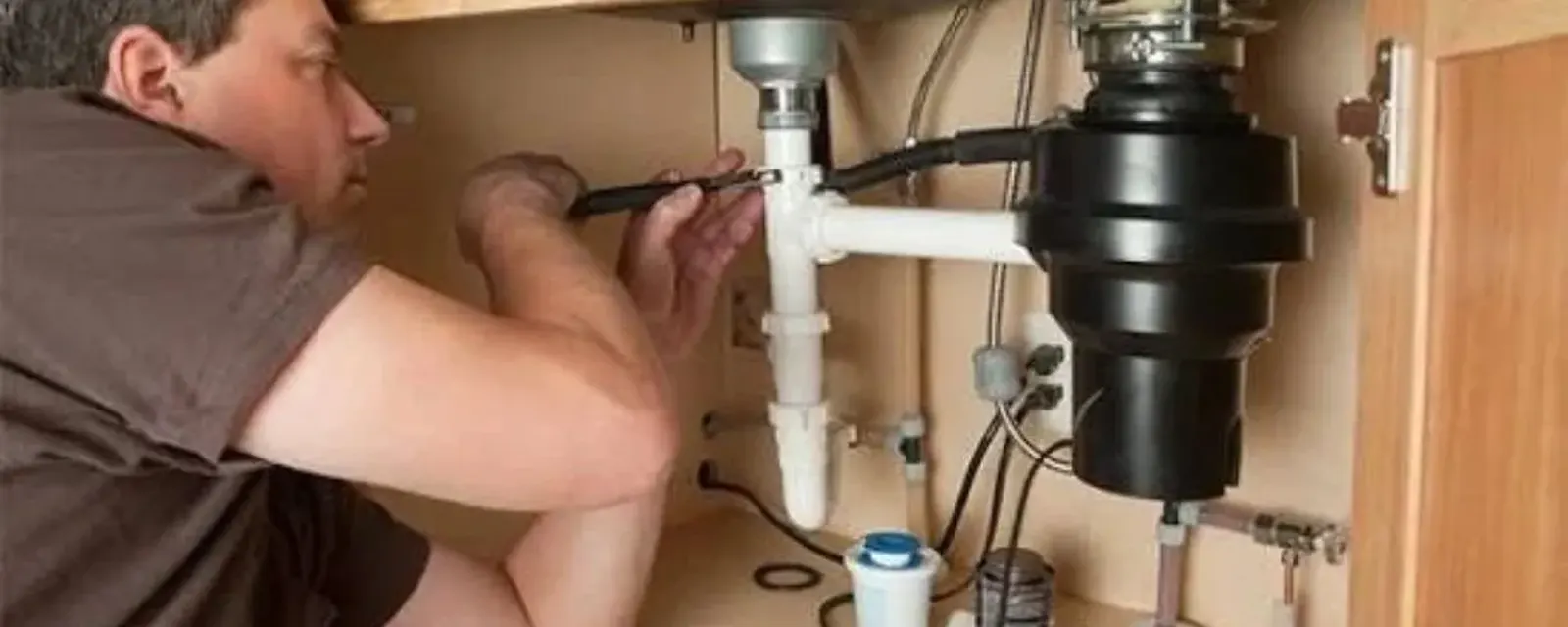
A disposal bolts to the sink flange from underneath using a mounting assembly, and its discharge outlet connects to the sink trap. If the home has a dishwasher, the dishwasher drain hose connects to a side inlet on the disposal, so food waste and dishwasher water share the same path to the drain.
Because everything connects at the disposal, a poor connection shows up as a leak in the cabinet, a slow sink or a dishwasher that does not drain. That is why the order of assembly matters, and why the manufacturer's instructions for your model take priority over any general advice.
Part by part: what to prepare
| Component | What it needs | Common snag |
|---|---|---|
| Sink flange and mount | A standard drain opening and a clean flange seat | Old putty or a cracked flange prevents a seal |
| Electrical supply | A switched outlet or hardwire connection to electrical code | No power under the sink means an electrician is involved |
| Discharge to trap | An outlet that lines up with the trap and trap arm | A trap that does not fit needs new connectors or a reconfigured layout |
| Dishwasher connection | The dishwasher hose attached to the disposal inlet | The knockout plug must be removed or the dishwasher will not drain |
| Cabinet space | Clearance below the unit and room for tool access | Cleaning supplies and pipes crowd the space |
The installation sequence in plain terms
Always follow the disposal manufacturer's instructions and the dishwasher's instructions, because mounting hardware differs between brands.
Disconnect power and clear the cabinet
Unplug the old unit or switch off its circuit. Remove stored items, and place a bucket under the trap.
Remove the old disposal or drain parts
Detach the dishwasher hose, the trap and the discharge, then loosen the mounting ring and lower the unit.
Prepare the sink flange
Clean off old putty, install the new flange with the sealant the manufacturer calls for, then attach the mounting ring from below.
Handle the knockout and connect the dishwasher
If a dishwasher drains into the disposal, punch out the plug in the inlet before mounting. Then attach the hose with its clamp.
Mount, connect the trap and test
Lock the unit to the mount, reconnect the discharge and trap, restore power, run water and check every joint for leaks.
Dishwasher details that people get wrong
The knockout plug
A new disposal usually has a plug blocking the dishwasher inlet. If you skip removing it, the dishwasher cannot drain, and you will find standing water in the machine.
Dropped plug in the unit
After punching the plug out, fish it from the grinding chamber. A loose plug can jam the unit the first time it runs.
Anti-flood loop
Dishwashers are normally connected with a high loop or an air gap so drain water cannot flow back into the machine. Follow the dishwasher's instructions and local code on which applies.
Hose kinks
A kinked or crushed drain hose slows drainage and causes odor. Route it with gentle curves.
Clamp tightness
A loose clamp weeps slowly and rots the cabinet floor. Tighten it, then check again after the first dishwasher cycle.
What you can tackle and what needs a professional
Reasonable for a handy homeowner
- Replacing an existing disposal with a similar model that has the same mounting and outlet.
- Reconnecting the trap and tailpieces with new connectors of the same size.
- Punching out the dishwasher knockout and connecting the hose per instructions.
- Plugging in a unit to an existing switched outlet that already serves the old one.
Better with a licensed plumber or electrician
- Adding a first-time disposal where no power is available under the sink.
- Changing the drain layout, moving the trap or opening the wall.
- A trap, drain or sink that leaks or is damaged for reasons other than the old disposal.
- A kitchen that has repeated slow drains, which suggests a problem beyond the sink.
Choosing the unit: feed type, motor and noise
Continuous feed units run while the switch is on and you add scraps as you go. Batch feed units run only when a stopper is in place, which some households prefer for safety. Both fit the same sink opening, but batch feed models need their own switch arrangement, so read the instructions before buying.
Motor size affects speed and jam resistance, while sound insulation affects how loud the kitchen gets. Sink style rarely limits the choice, but a very small cabinet may limit which models fit. Measure the space under the sink from the flange to the cabinet floor before you shop.
What shapes the cost of a disposal installation
Prices for the same disposal range widely because the work around it differs.
Horsepower and unit quality
Larger, quieter and better-insulated units cost more, and a bigger motor is not always better for a small household.
Electrical readiness
A switched outlet already in place makes the job simple. If none exists, an electrician's work is added.
Sink and drain compatibility
Specialty sinks, odd flanges and misaligned traps require extra parts and adjustments.
Dishwasher connection
A dishwasher that needs a new hose, loop or air gap increases parts and time.
Removal of the old unit
Corroded mounting rings and seized fittings take longer to remove.
An installation is a planned upgrade and not an insured loss, though damage from a sudden leak afterward may be handled under your policy.
Habits that keep a new disposal out of trouble
Run cold water before, during and for a short time after grinding. Feed food waste gradually rather than all at once, and keep grease, coffee grounds in bulk and fibrous scraps out of the unit. Grease cools in the trap and the pipe beyond it and forms the buildup that later slows the whole kitchen line.
A disposal is not a trash can. If the sink starts draining slowly after installation, the cause may be the line beyond the trap, and a drain cleaning visit can clear it. If the disposal itself hums or leaks, our garbage disposal repair page explains what we look at.
Wherever you live around the bay
These installation steps are the same whether your kitchen is in Coronado, Chula Vista or San Diego. What differs is who handles permits and which water district serves the home, so confirm those details with the city or utility before you plan the project.
Coronado note: swapping fixtures and who owns the line
Handout 301, the Coronado Building Division's March 2025 permit guide, allows like-for-like fixture swaps that touch nothing but the visible tailpiece, trap, trap arm and connectors. A like-for-like disposal swap normally stays inside that description. If your project reaches behind the wall, adds new piping or rearranges the drain, it goes beyond it, and permit rules vary, so ask the Building Division at (619) 522-7331 first.
Coronado's code, as summarized on the city's lateral page, puts the sewer lateral on the homeowner, running from the house through the connection to the City main. A disposal sends more solids and grease residue down your own pipe, and that pipe is yours all the way to the main. Pay attention to grease habits, and if kitchen drains slow down often, a sewer camera inspection shows the condition of your lateral.
Need a plumber now?
The 24/7 line is open for Coronado homes and businesses.
Questions about this topic in Coronado
The city's handout allows a like-for-like swap that replaces only visible tail pieces, the trap and connectors. If the work adds or rearranges piping, the Coronado Building Division is the place to ask, since permit rules vary by project.
The most common cause is the dishwasher knockout plug in the disposal inlet, which has to be removed before the hose is connected. A kinked hose or a missing high loop can also cause it. Check the plug first, then the hose route.
Under Coronado's code, the owner is responsible for the lateral all the way through the connection to the City main. A clog in your home line is yours to clear, while the city handles the main in the street.
Not as a simple swap. You need power that is installed to electrical code, either an outlet controlled by a wall switch or a hardwired connection. That is electrical work, so hire a qualified electrician before the plumbing part begins.
A mid-range motor handles typical household scraps. Larger units grind more quickly and run quieter, but they cost more and need cabinet space. Choose by how you cook and the space under the sink, not simply the biggest number.
Grease and oil, large amounts of coffee grounds, fibrous vegetable scraps such as celery or corn husks, bones, pasta and rice in bulk, and anything that is not food. These cause blockages in the trap or the line beyond it.
Sources and standards behind this page
Every local rule or figure above comes from a published source, listed here so you can check it.
- City of Coronado Community Development, Building Division, Handout 301 (March 2025)
- City of Coronado municipal code and lateral information page (sewer lateral ownership)