Stop the water first, then ask questions
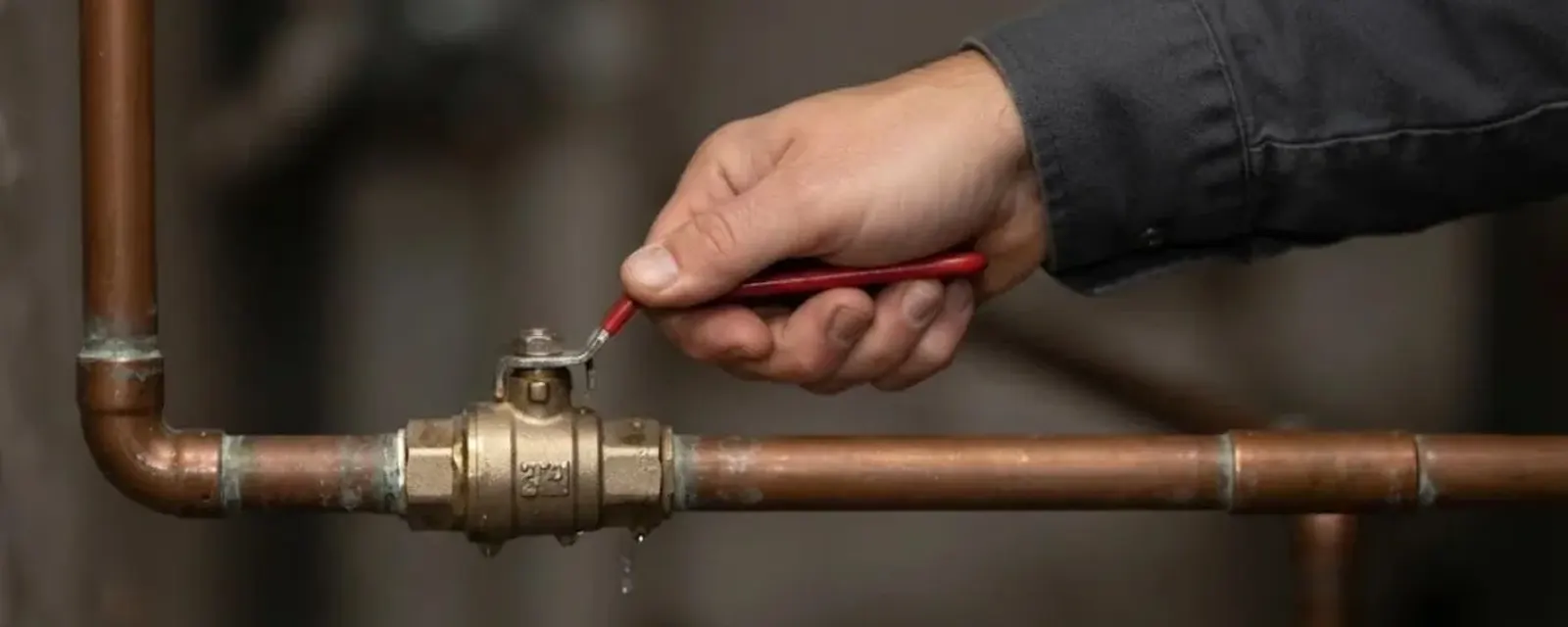
When a pipe bursts, close the main water shutoff for the house. Turn a round wheel handle clockwise until it stops, or turn a lever handle a quarter turn so it sits crosswise to the pipe. Then open a faucet at the lowest point of the house to drain the lines and confirm the flow has stopped. Everything else can wait.
The trouble is that many people have never touched this valve and are not sure which one it is. Valves seize with age, hide behind stored boxes and sit near a utility meter that looks like it should be turned too. The sections below sort out which valve is yours and how to be ready before you need it.
Burst pipe right now: the first five minutes
If water is spraying or pouring, work through this list in order and call while you do it.
- Close the main shutoff valve for the house, turning clockwise or a quarter turn depending on type.
- Open the lowest faucet and the highest one to drain the system and relieve pressure.
- Turn off the water heater power or gas so the element or burner does not run on an empty tank.
- Switch off electricity to wet areas at the panel only if you can reach it without stepping in water.
- Move valuables, rugs and electronics out of the wet area, and photograph the damage for insurance.
- Call our 24/7 line at (619) 927-0312 for a plumber to find the failed section and repair it.
The house main versus the meter-side valve
Two valves can sit on the line, and they are not equal. Treating them the same causes damage and, sometimes, conflicts with the utility.
The house main shutoff
- Belongs to the homeowner and serves the whole house.
- Is the valve you should close in an emergency.
- Should be exercised twice a year so it does not seize.
- Can be replaced by a plumber if it leaks or will not close.
- May be a wheel handle or a lever handle, depending on age.
The meter-side valve
- Sits at or near the utility meter and is typically the utility's equipment.
- Is often operated with a special key or tool, and force can damage it.
- Should not be used for routine shutoff unless the utility tells you to.
- Is the right call to the utility if it is the only valve that works.
- Is sometimes the only way to stop a leak between the meter and the house.
Finding your valve before the emergency
Spend ten minutes on this the weekend you read it. Tracing the supply pipe is far easier on a dry floor than a wet one.
Follow the water heater supply
Find the cold line feeding the top of your water heater and trace it back toward where water enters the property. The first full shutoff on that run is a candidate.
Check utility spaces and exterior walls
Garages, utility closets, crawlspaces and exterior wall panels are common places for a main valve, so look at each.
Identify the handle type
A round wheel is a gate valve and takes several turns. A lever is a ball valve and takes a quarter turn. Knowing which you have changes how you operate it.
Confirm it with a faucet
Close it, open a faucet and see whether the flow stops within a minute. If not, you may have a branch valve rather than the main.
Tag it and tell the household
Hang a bright tag on the valve, take a photo and make sure everyone in the house, including teens and renters, knows where it is.
Valve types and how they fail
| Valve type | How you recognize it | How to close it | Common problem |
|---|---|---|---|
| Gate valve | Round wheel handle, often older | Turn clockwise several full turns until firm | Stem corrodes and the gate can break or stick, so the handle spins without closing |
| Ball valve | Straight lever handle, common on newer work | Turn the lever a quarter turn across the pipe | Handle can seize if never moved, but it rarely breaks internally |
| Angle stop at a fixture | Small oval or round handle under a sink or toilet | Turn clockwise by hand | Isolates only that fixture, so it does not replace the main |
| Meter-side valve | Flat or T-shaped stem inside the meter box | Special key, typically the utility's | Easy to damage, and the utility may need to repair it |
Test and tag your shutoff twice a year
Valves that never move are the ones that fail when you need them most. A quick exercise keeps them freer.
- Pick two dates you will remember, such as when the clocks change, and put them in your phone calendar.
- Close the main slowly until it stops, then open it fully again, and avoid forcing a stiff handle.
- Run a faucet after closing it to confirm the flow stops completely or nearly so.
- Look at the valve for drips around the stem or body, and wipe it dry to check again later.
- Replace any valve that will not close or that leaks at the stem, since a bad one gives false comfort.
- Keep the area around the valve clear of boxes, paint cans and garden gear.
Why you open it slowly
Slamming a lever shut stops flowing water abruptly and sends a pressure spike through the pipes, which is the water hammer you may hear as a bang. Closing and opening any shutoff valve slowly keeps the shock down and protects older joints.
The same goes for turning water back on after a repair. Open the main a little, let the lines refill and check for drips, then open it all the way.
When the valve will not close
A gate valve that spins freely without stopping flow has a broken internal part. A valve that leaks around the stem needs repacking or replacing. Neither is a good thing to fight with while water pours, so use the next valve upstream if you have one and call for help.
Replacing a failed main is routine plumbing work. If the pipe itself has split, it falls under burst pipe repair. If the damage is in the line coming into the house from the street, water line repair covers the buried section.
What affects the price of a shutoff valve job
Replacing a valve is usually a modest job, but access and condition change the scope. Expect a plain price stated before work starts.
Valve type
A quarter-turn ball valve is a common upgrade. Specialty or larger valves cost more in parts and labor.
Where it sits
A valve in an open utility area is simple, while one behind a wall or in a tight crawl takes longer.
Shutting down upstream water
If the house main does not close, the plumber may need the utility to stop the supply before the valve can be changed.
Pipe condition around it
Corroded or fragile pipe can crumble when disturbed, which expands the repair.
Damage already done
If water has soaked floors or walls, there may be drying and restoration beyond the plumbing.
Burst pipe water damage is often covered when it is sudden, but policies differ, so call your insurer promptly and keep photos and receipts.
Properties outside Coronado
If you own a house or rental elsewhere, the same twice-a-year test applies, and layouts differ. Our Chula Vista plumber and San Diego plumber pages describe how to reach a dispatcher in those areas.
Coronado note: the utility line and the permit exemption
California American Water lists a 24/7 emergency line at 1-888-237-1333. If the leak is on the utility side of the meter, or the only valve that stops the water is the one in the meter box, that is the number to call, and you should not force a utility valve. Ask what the utility will handle and what remains yours.
On the repair side, the City of Coronado Building Division's permit handout lists repairing leaks in pipes and valves as exempt from a permit. That means fixing a leaking valve or a split pipe does not require one to get started.
Replacing concealed piping or piping behind the face of a wall or below the floor is a different matter and does require a permit, so ask the Coronado Building Division before that work. Because home layouts vary, locate your own valve now rather than guessing during an emergency.
Need a plumber now?
The 24/7 line is open for Coronado homes and businesses.
Questions about this topic in Coronado
Close the main shutoff valve for the house. A wheel handle turns clockwise until it stops, and a lever handle turns a quarter turn so it sits across the pipe. Then open a low faucet to drain the lines and confirm the flow has stopped.
Use the house main first. The valve at the meter is generally the utility's equipment and can be damaged by forcing it or using the wrong tool. If it is the only valve that works, call the utility's emergency line.
California American Water lists a 24/7 emergency line at 1-888-237-1333. Call it if water is leaking at or before the meter and ask where the utility's responsibility ends. A plumber handles the house side.
Twice a year is a good habit. Close it slowly until it stops, open it fully and check for leaks around the stem. A valve that will not move, will not close or drips needs replacing before the next emergency.
The City's permit handout lists repairing leaks in pipes and valves as exempt. Work on concealed piping behind walls or under floors is different and needs a permit, and rules vary, so ask the Coronado Building Division.
Do not force it with a wrench or pipe extension, since the stem can snap. Use any other upstream shutoff if there is one, close fixture stops where you can and call a plumber. Penetrating oil sometimes helps a stiff but intact valve.
Sources and standards behind this page
Every local rule or figure above comes from a published source, listed here so you can check it.
- City of Coronado Community Development, Building Division, Handout 301 (March 2025)
- California American Water, Coronado system 2023 annual water quality report