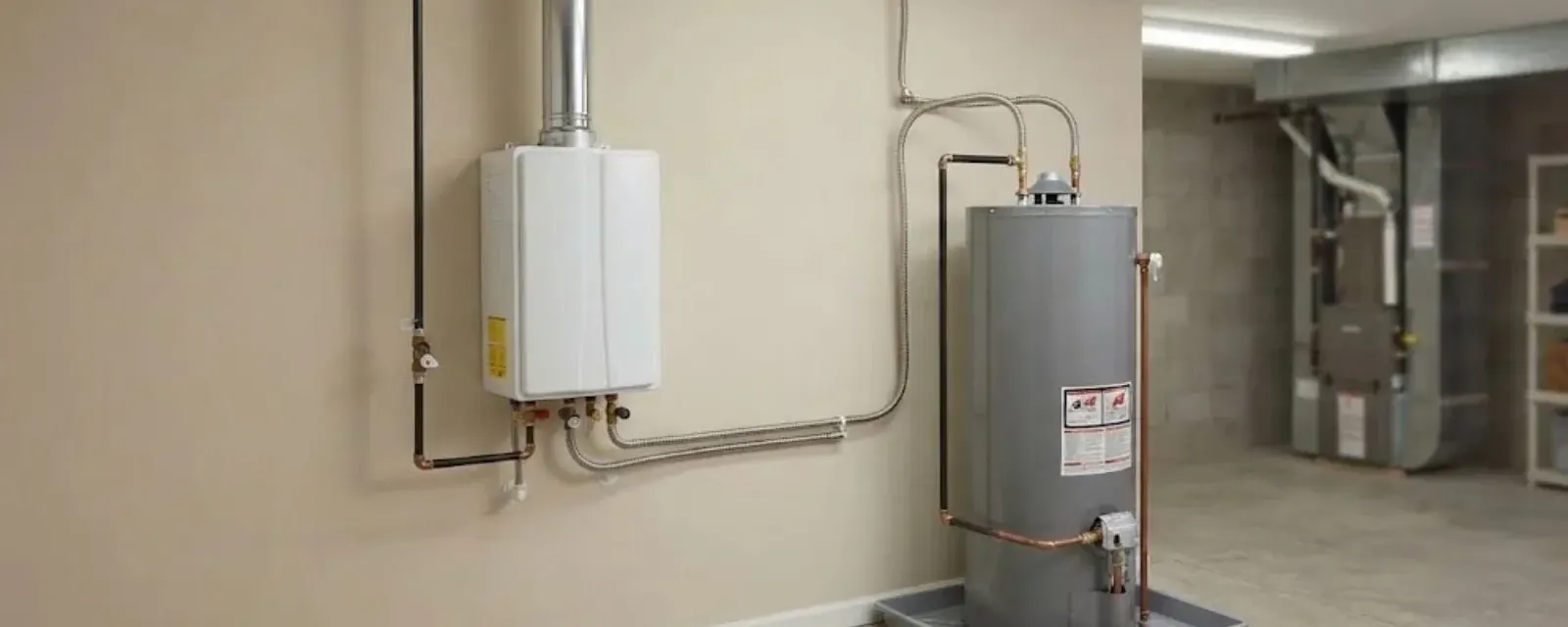
What the exhaust pipe does and who decides how it is built
A gas tankless water heater burns fuel very hot and very fast, and the exhaust pipe carries the combustion gases safely outside. Most modern units are direct vent, meaning a sealed pipe brings outside air in and another pipe sends exhaust out. The pipe material, the maximum length, the number of elbows and the distance from windows and openings are set by the manufacturer's installation manual and by local code.
That makes the exhaust the least flexible part of the job. You cannot swap a pipe type because it is cheaper, and you cannot bend the run to suit a wall. If the manual says a certain material, a certain slope and a certain termination kit, that is what goes in.
Direct vent versus room air: how the two approaches differ
Both exist, but the sealed version is the common choice for new installs because it does not depend on air inside the house.
Direct vent (sealed combustion)
- Pulls combustion air from outdoors through its own pipe, often a concentric or twin pipe arrangement.
- Keeps house air out of the burner, which helps in tightly sealed homes.
- Usually allows the unit to sit on an interior wall, garage wall or closet with a short run outside.
- Requires the exact termination kit and pipe types listed by the manufacturer.
Room air (open combustion)
- Draws air for combustion from the space around the heater.
- Needs enough open air volume or dedicated openings, per the manual and code.
- Is more sensitive to nearby exhaust fans, tight construction and dust.
- Is less common in new tankless models, so check what your unit supports before planning.
Vent materials: what goes where
Always confirm against the manual for your specific model, because approved materials differ by brand and by whether the unit is condensing.
| Unit type | Typical vent material | Condensate drain needed |
|---|---|---|
| Condensing tankless | PVC, CPVC or polypropylene, as listed by the maker | Yes, a drain line, often with a neutralizer |
| Non-condensing tankless | Stainless steel vent made for gas appliances | Usually no, but check the manual |
| Outdoor-rated tankless | Short vent or none, since the unit sits outside | Depends on the model |
| Replacing a tank heater | Old atmospheric vent is typically not reusable | A plumber confirms against the manual |
Five details inspectors and manufacturers look at
Termination clearance
The exhaust outlet must stay a set distance from windows, doors, vents and gas meters. The manual and the local code give the numbers, so measure before you choose a wall.
Pipe slope and support
Horizontal runs must slope as directed, usually back toward the unit on condensing models, so liquid drains instead of pooling.
Sealed joints
Joints are cemented, clamped or gasketed exactly as listed. A loose joint can leak exhaust gas into the house.
Length and elbow count
Every elbow adds resistance. Exceed the allowed equivalent length and the unit can throw errors or run poorly.
Combustion air path
The intake must stay clear of leaves, snow, insulation and stored items, and be located as the manual directs.
How a vent installation unfolds from start to finish
Knowing the order helps you spot shortcuts.
Pick the wall and measure clearances
The installer checks the exact termination point against the manufacturer's clearance chart, then marks the penetration.
Size the gas line
A tankless unit draws a large gas flow all at once, so the supply pipe is checked against the unit's rating before anything is cut.
Run and support the vent
Pipe is assembled dry first, sloped as directed, supported at the listed intervals, then joined with the approved method.
Connect condensate and test
On condensing units, the drain and neutralizer are installed. Then the unit is fired and the vent joints and flame are checked.
Permit inspection
The finished work is inspected by the city before the job is closed.
Warning signs that an existing vent needs a look
A tankless heater that has been running for a while can develop vent trouble. These signs are worth a professional inspection, and none of them are a reason to keep using the unit and hope.
Error codes about airflow
Repeated vent or ignition fault codes can mean a blocked intake, a long run with too many elbows or a loose joint.
Soot or staining at the outlet
Dark marks around the termination suggest incomplete combustion or exhaust that is not clearing properly.
Water dripping from vent joints
On a condensing unit, drips at a joint mean the slope or seal is wrong and the liquid is not reaching the drain.
Rattling or whistling in the pipe
Noise can point to a loose support, a partial blockage or a termination kit that is not seated correctly.
A carbon monoxide alarm that has gone off
Treat any alarm seriously, ventilate, leave the home and call 911 before anyone investigates the cause.
Gas smell or carbon monoxide alarm: act before you diagnose
Any sign of a gas leak or exhaust spillage is an emergency, not a repair project.
- If you smell gas, leave the building, then from a safe place call 911 or SDG&E.
- Do not flip light switches, use phones inside, or do anything that can spark.
- If a carbon monoxide alarm sounds, get everyone outside into fresh air and call 911.
- Do not restart the heater. Once the building is cleared, call our line and a licensed plumber can arrange an inspection.
What changes the price of a tankless vent job
Vent work is a big share of the total on a tankless install, and it depends on the building more than the heater. You should see the price in plain terms before anyone starts work.
Run length and routing
A short run through an exterior wall is simple. A long run through a ceiling, attic or around obstacles takes more pipe, support and labor.
Vent material
Stainless systems and specialty termination kits cost differently than plastic systems, and the manufacturer picks which one is allowed.
Condensate handling
Condensing units need a drain path and sometimes a neutralizer, which depends on where a drain is nearby.
Gas line upgrade
If the existing line is too small for the unit, the pipe has to be resized, which adds materials and inspection steps.
Wall and roof penetrations
Cutting through stucco, masonry or a roof requires patching and weather sealing afterward.
Insurance generally does not pay for a planned upgrade, and a vent problem that causes damage will be handled by your carrier under its own terms, so ask them directly.
What a homeowner can check and what stays with a licensed plumber
You can look at the outside termination every few months to make sure nothing blocks it, such as a bird nest, a stack of boxes or a climbing plant. You can also test your carbon monoxide alarm and replace its batteries on schedule.
You should not cut, glue, extend or reroute the vent pipe yourself, and you should not change gas piping. These are licensed jobs because a mistake can release exhaust or gas into the home. The installation page for tankless water heaters explains what a service visit covers, and plumbing installation work covers the gas and water piping around the unit.
Questions to ask before you approve a tankless install
- Which vent material and termination kit does the manufacturer list for this exact model?
- Where will the exhaust terminate, and how far is that from windows, doors and the gas meter?
- Is the existing gas line large enough for this unit, and who is doing the sizing?
- How is condensate being drained, and will the drain line be protected from clogging?
- Who pulls the permit and schedules the inspection?
- Will the old vent be removed or capped properly?
Neighboring cities, same manufacturer rules
Manufacturer instructions do not change at the city line. If you also own or manage a property in Chula Vista or San Diego, the vent rules from the manual apply there too, though each city handles permits and inspections its own way.
Coronado note: permit and gas line sizing
Handout 301, issued by the Coronado Building Division in March 2025, states that water heater installation requires a permit, and tankless units are named explicitly. That matters for the exhaust because the vent is inspected as part of the installation, so a vent changed without a permit can show up later when a buyer's inspector asks for the paperwork. Call the Building Division at (619) 522-7331 if you are unsure.
The same handout notes that existing gas lines may need to be altered, and that alteration requires gas line sizing calculations by a licensed plumber. A tankless heater pulls much more gas at once than a tank, so the line feeding it may be too small. Plan for that calculation before you buy a unit, and you can check any plumber's license at cslb.ca.gov, where plumbing is class C-36.
Need a plumber now?
The 24/7 line is open for Coronado homes and businesses.
Questions about this topic in Coronado
Usually not. Tank heaters often use an atmospheric vent that is sized and built differently from the sealed or stainless systems tankless units require. The manufacturer's manual states which vent system is approved, and a plumber should confirm before the old vent is reused or removed.
Condensing models pull extra heat from the exhaust, which makes the gases cool enough to form liquid inside the vent. That liquid has to drain away, and it can be acidic, so many units include a neutralizer. Your manual shows the required drain setup.
Yes. The Building Division's handout names tankless units among the water heaters that need a permit, and altering an existing gas line calls for sizing calculations by a licensed plumber. For other work on the vent or house, check with the Building Division, because rules differ by project.
Only if the manufacturer lists it for your model. Many condensing units allow certain plastic vent pipes, while non-condensing units generally require stainless steel. Using a material the manual does not approve is a safety and inspection problem.
The distance comes from the manufacturer's clearance chart and local code, and it varies by model and the type of opening. Do not guess. Ask the installer to show you the chart and mark the planned termination before any wall is cut.
Often yes with a sealed direct vent unit, because it brings in outside air through its own pipe. Check the allowed vent length and clearances in the manual, and keep the closet free of stored items that could block service access.
Sources and standards behind this page
Every local rule or figure above comes from a published source, listed here so you can check it.
- City of Coronado Community Development, Building Division, Handout 301 (March 2025)
- Contractors State License Board, cslb.ca.gov (plumbing is license class C-36)