The short version of the meter test
To find a hidden leak, stop every use of water inside and outside the house, then look at the water meter. If the small leak indicator keeps spinning, or the register numbers advance while nothing is running, water is escaping somewhere. Write down the reading, wait at least 30 minutes without using any water, and read it again. Any change means a leak.
The test settles an argument that otherwise drags on for weeks, namely whether a high bill came from household habits or from a pipe. Below you will find the exact steps, a table for reading the result, honest guidance on what you can chase yourself, and the point where a plumber with proper locating gear should take over.
Get the house truly quiet first
A meter test is only as good as the silence behind it. Most false alarms come from something running that nobody remembered.
- Close every faucet, shower and tub, and make sure nobody flushes a toilet during the test.
- Turn off the dishwasher, washing machine and any water-fed appliance such as an ice maker line or humidifier, or at least confirm they are idle and not mid-cycle.
- Switch off irrigation timers and shut any hose bibbs, since a sprinkler zone that fires during the test ruins the result.
- Check whether a water softener or filter is set to regenerate or backwash during your test window, and pause it if you can.
- Tell everyone in the house what you are doing, because one hand wash at minute twelve restarts the clock.
- Gather a flashlight, a pen and paper, a phone for timestamps and a rag, since meter boxes are often damp and dirty.
The timed reading, step by step
Allow about 40 minutes the first time, mostly spent waiting.
Find and open the meter box
Look near the front property line or curb for a lid set in the ground. Lift it with a screwdriver or a meter key, watch for insects, and brush debris off the glass face before you read it.
Locate the leak indicator
Most residential meters carry a small triangle, star or dial that turns when even a trickle passes through. If it moves with every tap closed, that alone is a strong hint of a leak.
Record the full register
Write down every digit on the main register, including the small sweep dials, and note the time. A phone photo with a timestamp works well as backup.
Wait without using water
Leave the house alone for at least 30 minutes. For a slow leak, an hour gives a cleaner result, and a few hours overnight is better still.
Read it again and compare
Any advance in the numbers, or a leak indicator that kept turning, means water moved while nothing should have. Note how far it moved and over how long.
What your result is telling you
Use this as a rough decision frame. Meters differ, so treat the numbers as direction, not diagnosis.
| What you see | What it usually means | Sensible next move |
|---|---|---|
| Indicator still, numbers unchanged after 30 minutes | No active leak at that moment, though an intermittent one could still exist | Repeat overnight or during a time of day when the bill seems to climb |
| Indicator creeping slowly, numbers barely moved | A small drip, often a toilet flapper, a faucet or a pinhole in a line | Dye test the toilets, then check fixtures one at a time |
| Indicator turning steadily, numbers clearly advancing | A larger leak in a supply line, a stuck valve or a running appliance fill | Close the house shutoff and read again to find which side of it the leak is on |
| Movement stops when the house main is closed | The leak is on your side, inside the house or in the buried line to it | Isolate zones, then call for leak location if you cannot find it |
| Movement continues with the house main closed | The leak may sit between the meter and your shutoff, or the shutoff is not sealing | Call the utility emergency line and a plumber, and avoid digging |
Where the water is usually going
The most common silent leak in any house is the toilet. A worn flapper lets water seep from the tank into the bowl all day, and the refill valve quietly tops it up. Drop a few dots of food coloring into the tank, wait 15 minutes without flushing, and look at the bowl. Color showing up there confirms the flapper is not sealing.
Next on the list are irrigation valves that weep, a water heater relief valve that dribbles to a drain, and fixtures with a worn cartridge. Those leave a trail you can see if you look. The leaks that fool people live behind walls, under slabs or in the buried supply line, where no one is looking and nothing drips onto a floor.
Why small numbers matter
A leak that moves the dial only a little still runs around the clock. A toilet that loses a thin stream into the bowl wastes water all day and night, and nobody hears it. Multiply even a modest overnight reading by 24 hours and a month of days and the bill makes sense.
That is why timing matters more than eyeballing. Read the meter, wait, and read again. A number written on paper beats a feeling about the water bill every time.
Chase it yourself or call a plumber
Plenty of leaks are findable with ordinary patience. Others need tools you do not own, and guessing can cost you walls.
Reasonable to do yourself
- Running the meter test and recording readings.
- Dye testing toilets and replacing a flapper with a matching part.
- Closing the house shutoff and reading again to split the system in two.
- Looking at hose bibbs, irrigation valve boxes and under sinks for dampness.
- Checking the water heater area for a wet floor or a dripping relief line.
Better to call for
- Movement on the meter with every fixture proven off and no visible wet spot.
- A suspected leak in a wall, ceiling or slab, where opening things up blindly makes things worse.
- A wet or sunken patch of yard that stays damp when the weather has been dry.
- Any leak that continues with your house shutoff closed.
- Pipe repairs that involve replacing concealed lines, which can trigger permit requirements.
What a plumber does that you cannot
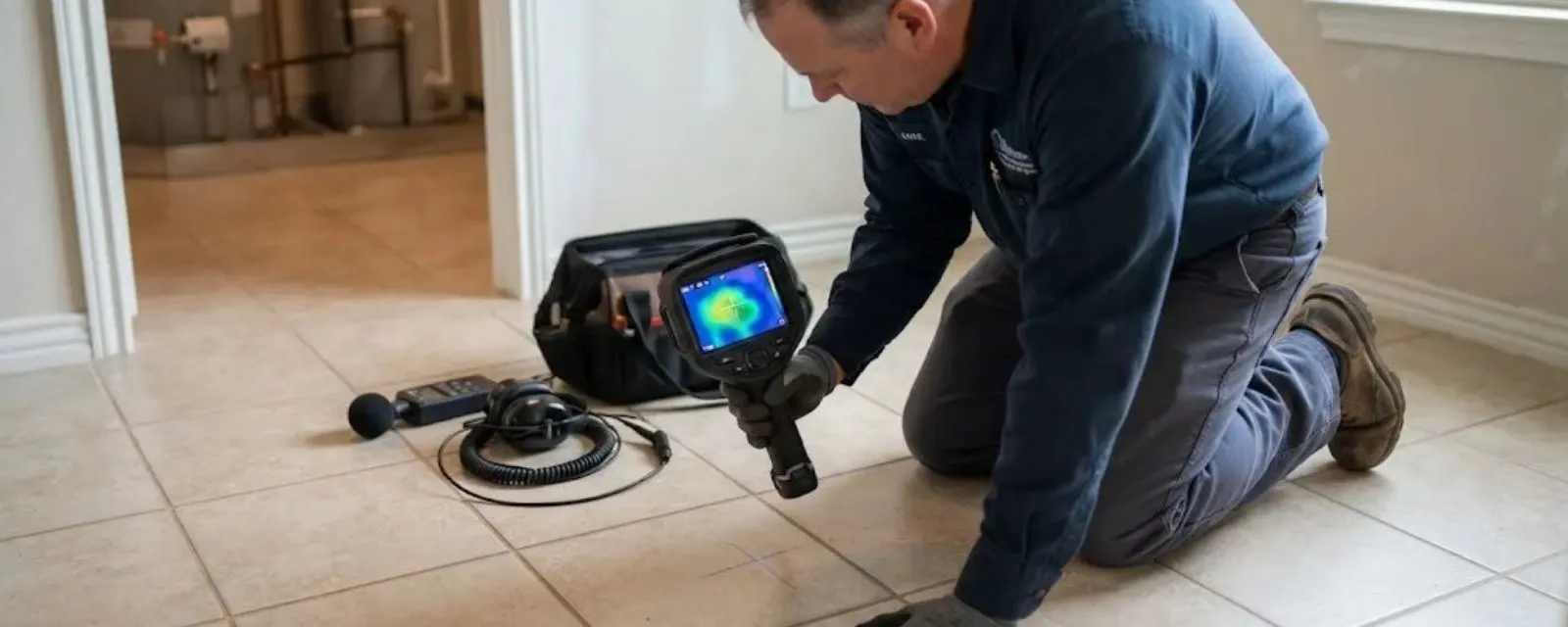
Professional leak detection pairs the same meter logic with acoustic listening gear, pressure isolation of individual lines and thermal imaging for hot water leaks. Rather than cutting drywall and hoping, the technician narrows the leak to a few feet first and opens up only that spot.
Once the location is known, the repair depends on the pipe. An exposed supply line is a short job, while a leak in the buried line from the meter calls for water line repair, which can mean trenching or a trenchless replacement. Either way you start from a measured number, not a guess.
What drives the cost of finding and fixing a hidden leak
Expect the number to depend on how hard the leak is to reach. A plumber will state a clear price before work starts, once the problem has been seen.
How the leak is found
A leak that reveals itself with a dye test is a small job. One that needs listening gear and line isolation takes more time and equipment.
Where the pipe runs
Exposed lines in a utility room are quick to reach. Pipe in a wall, under a slab or beneath hardscape adds access work and restoration.
Pipe material and condition
A single failed joint is different from a line that is corroded along its length, where a repair may only buy time.
Surface restoration
Opening a wall or lifting flooring means patching afterward. Locating the leak precisely keeps that area as small as possible.
Permits and inspections
Some pipe work needs a permit and some does not, so the scope of the fix changes the paperwork.
Some homeowner policies cover sudden water damage but treat a long-term seep differently, so call your insurer before repairs begin and keep your meter readings and photos as a record.
Coronado note: when the leak is on the utility side
California American Water, the utility behind the Coronado system, says on its customer page that many leaks are not noticeable but still add to unexpected water use. That matches what the meter test finds, and it is a good reason to run the test whenever a bill surprises you rather than waiting for a damp spot to appear.
Cal Am also lists a 24/7 emergency line at 1-888-237-1333. If your test suggests the leak sits between the meter and the street, or water is surfacing at the meter box itself, that line is the right call for a utility-side problem. Ask them where the utility's responsibility stops and yours starts before anyone digs.
The same meter logic applies if you own a rental or a second property across the bay. Our pages for a plumber in Chula Vista and a plumber in San Diego cover those service areas, though the utility serving that address may be a different one, so check the bill for the right number before you call about a meter.
Need a plumber now?
The 24/7 line is open for Coronado homes and businesses.
Questions about this topic in Coronado
Thirty minutes is the minimum and works for moderate leaks. A slow leak may only show after an hour or two, and the cleanest test is overnight when nobody is awake to use water. Record the time of each reading.
Close the house main and look again. If it stops, the leak is on your side, most likely a toilet, a hidden line or the buried pipe to the house. If it keeps turning, call the utility and a plumber.
Call California American Water's 24/7 emergency line at 1-888-237-1333 for a problem on the utility side. Tell them what you see at the meter and ask where their responsibility ends before you or a plumber start any digging.
Yes. A flapper that does not seal lets water trickle from the tank into the bowl around the clock, and the fill valve replaces it. Dye in the tank, 15 minutes without flushing, and a colored bowl will confirm it.
It works, but pause both first. A softener that regenerates or a sprinkler zone that starts during the test will move the dial and hide the real answer. Close hose bibbs and turn timers off before you begin.
Treat it as urgent if the meter spins fast, water appears at the meter box, ceilings stain or floors feel warm or soft. Close the house shutoff and call our 24/7 line at (619) 927-0312 so a plumber can look.
Sources and standards behind this page
Every local rule or figure above comes from a published source, listed here so you can check it.
- California American Water, Coronado system 2023 annual water quality report