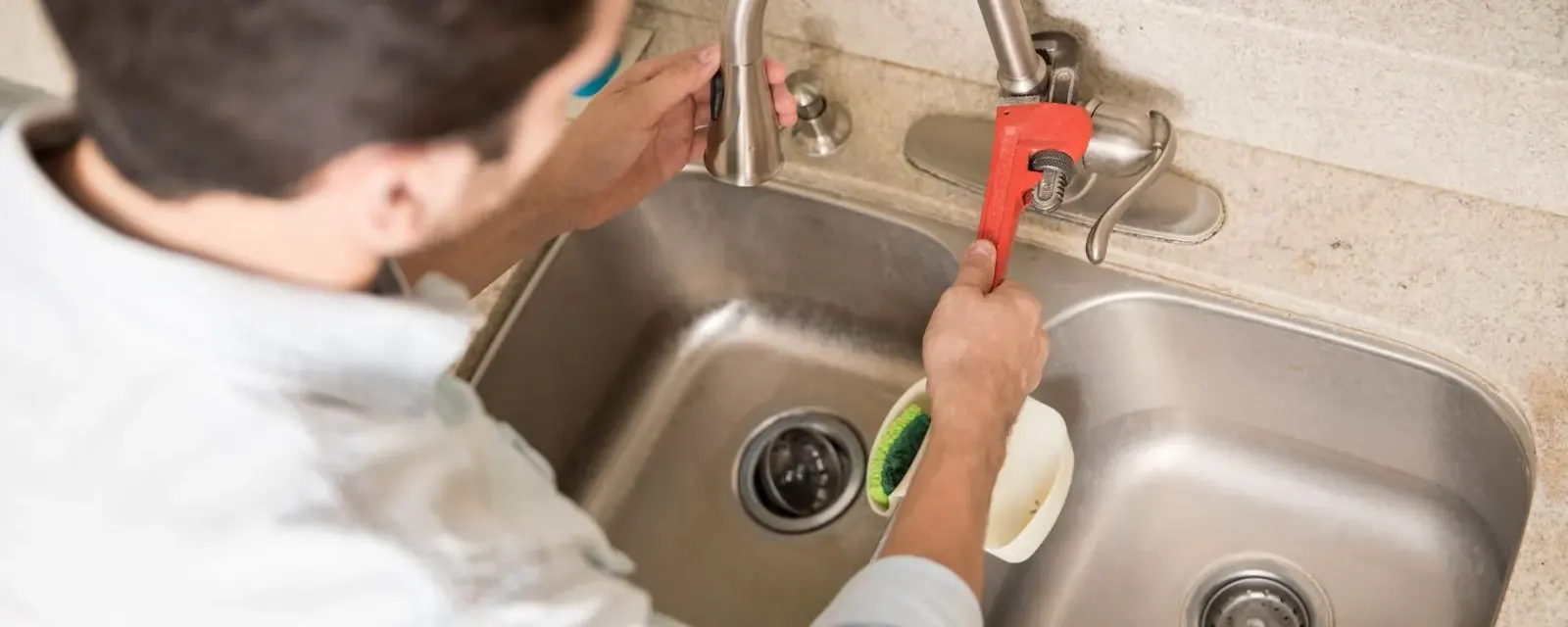
The short answer: five parts, five different symptoms
A faucet that drips, sprays sideways, runs weak or leaks at the base almost always has one worn part, not a dead faucet. The usual suspects are the cartridge, the aerator, the O-rings, the valve seats and the supply lines. Each one produces a different symptom, so the symptom tells you where to look.
A clogged aerator is the easiest fix and takes a few minutes. A worn cartridge or O-ring is a manageable weekend job on most single-handle faucets. Corroded seats, a cracked body or a leak inside the wall are the point where a plumber saves you time and a flooded cabinet.
Symptom to part: a quick diagnosis chart
Match what you see to the likely part before you buy anything. Bring the old part to the store, because faucet parts are brand and model specific.
| What you notice | Likely part | DIY or call |
|---|---|---|
| Weak flow or spray going sideways from the spout | Aerator clogged with mineral scale or debris | DIY. Unscrew, clean or replace the aerator. |
| Steady drip from the spout when the handle is off | Worn cartridge or damaged valve seat | DIY for a cartridge. Call if the seat is pitted. |
| Water seeping around the handle or the base of the spout | Dried or cut O-rings | DIY on most faucets with the right O-ring size. |
| Handle is stiff, gritty or will not shut off fully | Scaled cartridge | DIY. Replace the cartridge as a unit. |
| Wet cabinet floor under the sink with the faucet off | Supply line or its connection | DIY if the shutoff valve works. Call if it will not close. |
| Drip that returns right after a new cartridge | Pitted valve seat or damaged faucet body | Call. Replacing the whole faucet is often cheaper. |
How a basic cartridge or O-ring repair goes
Models differ, so use the manufacturer's instructions for your faucet. The sequence below is the same for most kitchen and bathroom faucets.
Shut off the water first
Close the two small shutoff valves under the sink. Open the faucet to drain pressure and plug the sink drain so a dropped screw does not disappear.
Take photos as you disassemble
Remove the handle, trim cap and retaining nut in order, photographing each layer. The pictures save you when it is time to reassemble.
Pull the cartridge and compare it
Lift the cartridge straight out and match it to the replacement by size, stem shape and brand. A near match that is slightly off will leak again.
Clean the housing, then replace the O-rings
Wipe mineral deposits out of the valve body with a soft cloth. Use the O-rings supplied with the new cartridge, and a little plumber's grease if the maker allows it.
Reassemble and test slowly
Turn the shutoffs back on gradually with the faucet open, let air escape, then check for drips at the handle and under the sink.
Do it yourself or call a plumber
The line between the two is mostly about access and what you find once the faucet is open.
Reasonable to try yourself
- Cleaning or replacing an aerator, since it threads onto the spout by hand or with a small wrench.
- Swapping a cartridge or O-rings when the shutoff valves under the sink close fully.
- Replacing flexible supply lines with new ones of the same length and connection type.
- Replacing a faucet with the same style when it mounts in the existing holes.
Better handled by a plumber
- Shutoff valves that will not close or that drip when you turn them.
- A leak that continues after the cartridge and O-rings are new, which points to the seat or body.
- Corroded fittings that twist or crumble instead of loosening.
- Wall-mounted faucets, tub and shower valves, or anything where the valve sits behind a finished wall.
Part by part: what each one does and how it fails
Knowing the job of each part makes the repair less mysterious.
Cartridge
It controls flow and temperature in a single-handle faucet. Scale and wear let water slip past, which shows up as a drip or a gritty, hard-to-turn handle.
Aerator
The screen at the spout tip mixes air into the stream. Grit and mineral flakes block its holes, which cuts flow and bends the spray.
O-rings
Small rubber rings seal the spout swivel and the cartridge. They harden and crack with age, so leaks appear where parts move.
Valve seats and springs
In older compression faucets, rubber washers press on metal seats. Pitted seats chew through new washers, so the drip comes back.
Supply lines
Braided or plastic hoses connect the shutoff valves to the faucet. They can weep at the nut or split, and a slow leak here often stays hidden under the sink.
What affects the price of a faucet repair
Prices vary a lot, so these are the factors that move the total up or down. We give a clear price before work starts, after we see the faucet.
Part availability
A common cartridge is simple to source. Discontinued or imported models can mean a longer search or a full faucet swap.
Faucet style
Single-handle kitchen faucets are usually quick. Widespread bathroom sets, wall mounts and tub spouts take more disassembly.
Condition of the shutoff valves
If the valves under the sink are stuck or leaking, they often need replacing first, which adds work.
Repair versus replace
When the body or seats are worn, a new faucet can be the better value than repeated repairs on an old one.
Access
A tight vanity or a sink full of stored items slows the job and affects the labor time.
Homeowner insurance usually treats a worn part as maintenance, but it may respond to sudden water damage from a failed supply line, so check your policy and keep photos.
Before you start: a one-minute prep list
- Locate and test both shutoff valves under the sink before you take anything apart.
- Photograph the faucet label or underside so you can name the brand and model at the parts counter.
- Lay a towel in the cabinet and a small bowl on the counter to hold screws and caps.
- Plug the sink drain so small parts cannot fall in.
- Have the manufacturer's instructions open, either printed or on a phone, for your exact model.
- Decide in advance where you will stop and call a plumber if a fitting will not turn.
Habits that make faucet parts last longer
Do not crank a handle past its stop. Hard shutoff force wears the cartridge and the seat faster than gentle use. If a handle needs muscle to close, the cartridge is telling you it is ready for replacement.
Clean the aerator when the stream first starts to look uneven, not after it has fully clogged. Scale that builds quietly hardens, and removing it gets harder each month.
If you are comparing quotes for a repair, ask whether the price covers the part, the shutoff valve condition and cleanup. A faucet repair visit should end with the drip stopped and the cabinet dry.
When the problem is bigger than the faucet
A faucet that has multiple problems at once, such as low pressure at every tap in the house, is usually not a faucet issue. That pattern points to the water line or the pressure at the meter, and our water line repair page explains how that diagnosis goes.
If the cabinet is damp and you cannot find a drip at the faucet, the leak may be in a supply line, a trap or a drain connection. We also dispatch to homes in Chula Vista and downtown San Diego, and the same under-sink checks apply on both sides of the bay.
Coronado note: hard water and what the permit handout allows
The California American Water 2023 annual water quality report for the Coronado system lists total hardness of 145 to 280 ppm as calcium carbonate, which works out to 8.5 to 16.4 grains per gallon. On the USGS scale that is hard to very hard, so mineral scale builds on aerators and cartridges here faster than many people expect. In practice, check the aerator whenever the stream looks uneven and expect to replace cartridges on a shorter schedule.
The City of Coronado Building Division's permit handout, Handout 301 from March 2025, treats clearing stoppages and repairing leaks in pipes, valves or fixtures as exempt from a permit. It also allows in-kind fixture replacement when only exposed tail pieces, traps, trap arms and connectors are replaced. A cartridge swap or a new supply line fits that description. Moving valves or opening a wall does not, so call the Building Division at (619) 522-7331 if the job grows.
Need a plumber now?
The 24/7 line is open for Coronado homes and businesses.
Questions about this topic in Coronado
Yes, it can. Water at 8.5 to 16.4 grains per gallon, the range in Cal Am's 2023 report, carries minerals that leave scale inside the cartridge and on the aerator. Expect stiffer handles and weaker flow sooner than with soft water. A softener or filter changes this.
The most common cause is a pitted or scaled valve seat, which stops the new cartridge from sealing. Another is a cartridge that is close to but not exactly the right model. If the seat is damaged, replacing the whole faucet is often more practical than repairing it.
Clean it first. Unscrew it, brush out the debris and soak it in white vinegar for a short time to loosen scale. If the screen is bent, cracked or the threads are stripped, replace it with the same size from the manufacturer or a hardware store.
The City of Coronado Building Division handout exempts repairing leaks in fixtures and allows in-kind fixture replacement when only exposed tail pieces, traps and connectors change. Moving or replacing valves or concealed pipe is different, and permit rules vary, so ask the Coronado Building Division before you start.
Dry the line and the shutoff valve with a paper towel, then run the faucet and check the towel after a few minutes. Dampness at the nut or along the braid means the line needs replacing. A slow leak can stay hidden, so check under the sink every so often.
Repair makes sense when the body is sound and parts are easy to find. Replace when the finish is peeling, the body is corroded, parts are discontinued or the same drip keeps returning. A plumber can tell you which side of that line your faucet is on.
Sources and standards behind this page
Every local rule or figure above comes from a published source, listed here so you can check it.
- City of Coronado Community Development, Building Division, Handout 301 (March 2025)
- California American Water, Coronado system 2023 annual water quality report