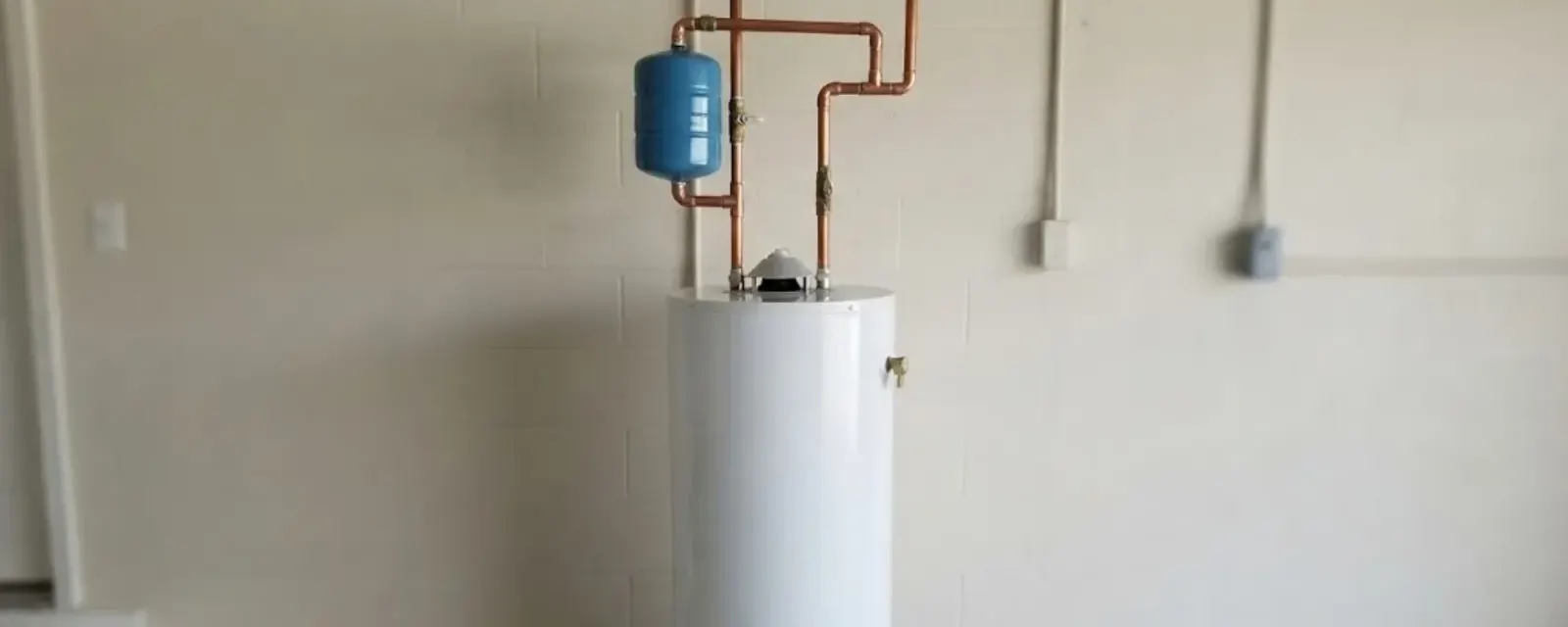
The honest answer about price
No honest article can name your price without seeing the heater, the closet and the gas or electric supply. Two homes with the same size tank can differ by a large margin because one needs a simple swap and the other needs new venting, a new gas line size, a new circuit or a repaired platform.
What can be said is which factors push the number up and which keep it down. Knowing them lets you compare quotes fairly, because a low quote that leaves out permit, bracing or venting is not really lower. We give a clear price before work starts, written for your specific install.
Three heater types and what each one asks of the house
| Type | What it needs | Where cost tends to rise |
|---|---|---|
| Tank, gas | Gas supply, a vent to the outside, drain pan or safe location, bracing | Replacing a worn vent, correcting clearances, upgrading connectors |
| Tank, electric | A dedicated circuit of the right size, bracing, safe drain | Panel capacity, new wiring, long wire runs |
| Tankless, gas | Larger gas supply, approved vent, condensate drain on condensing models, wall space | Gas line resizing, longer vent runs, wall penetrations |
| Heat pump | Electric circuit, room and airflow around the unit, condensate drain | Space limits, electrical upgrades, drain routing |
What to do before you compare quotes
Photograph the data label on your current heater and note whether it runs on gas or electricity, its tank size and where it sits. Quotes only line up when every plumber is pricing the same unit, venting and access.
Ask each plumber what is included, such as permit work, earthquake bracing, hauling away the old tank and any gas line changes. Checking each license at cslb.ca.gov takes a minute and avoids surprises.
The factors that move the total
Read these as a checklist of questions to ask each installer.
Type and capacity
A bigger tank, a high-output tankless unit or a heat pump with a larger tank costs more to buy and sometimes more to install.
Fuel and supply line
Switching from electric to gas, or gas to electric, means new piping or wiring. Sizing a gas line for a tankless unit can be the largest add-on.
Venting
A new vent route, a different pipe material or a longer run through walls and ceilings adds materials and labor.
Permit and inspection
Permit steps take time, and the installer has to coordinate the inspection before the job counts as finished.
Bracing, pan and code items
Earthquake bracing, an expansion tank where the system calls for one, a pan, and updated shutoff and relief piping all add parts.
Access and disposal
Attic, crawlspace and tight closet installs take longer, and removing the old tank has a labor component.
Insurance does not usually pay to replace a worn-out heater. If a sudden leak damaged the home, your policy may cover the damage but typically not the heater itself, so ask your carrier.
Sizing: why bigger is not automatically better
A tank that is too small runs out during back-to-back showers, while one that is too large costs more to buy and keeps more water hot than the household uses. Size by how many people live in the home and when they use hot water at the same time.
For tankless, size by flow and temperature rise instead. That means counting how many fixtures run together and how much the water must be heated from its incoming temperature. An undersized unit disappoints, and an oversized one pushes the gas line and vent requirements up for no benefit.
Tank versus tankless: where the extra work hides
Tank water heater
- Often a like-for-like replacement when size and fuel stay the same.
- Uses the existing gas line and vent if they are in good condition and sized right.
- Needs bracing, a drain path and proper relief piping.
- Holds a limited volume, so recovery time matters in larger households.
Tankless water heater
- Often needs a larger gas line, a different vent system and a condensate drain path.
- Mounts on a wall, so framing and clearances matter.
- Delivers continuous hot water at a given flow rate, so sizing is by flow and temperature rise, not volume.
- Benefits from isolation valves so it can be flushed on schedule.
Hidden items that show up on a bill
Old connectors and shutoffs
Corroded valves and flexible connectors are best replaced while the heater is out, and the installer should say so before the work.
Expansion tank
In a closed plumbing system, heated water needs somewhere to expand. Whether a tank is needed depends on the system and local code, so ask your installer.
Relief valve and discharge pipe
The temperature and pressure relief valve needs a properly routed discharge. Reusing an old one is not a good place to save.
Drain pan and leak protection
A pan or a leak alarm protects floors, especially where the heater sits above living space.
Platform and clearance repairs
A rotted stand, a cramped closet or missing clearances are fixed before the new unit is set.
What a proper installation visit includes
A clear scope makes quotes easier to compare.
Assess the site
The installer checks the size, fuel, vent, gas line or circuit, clearances, access and bracing before quoting.
Handle permit and shutdown
The permit is arranged, then water, gas or power is isolated and the old heater is drained.
Set, brace and connect
The new unit is placed, braced to the structure, connected to water, fuel and vent, and fitted with relief piping.
Test and fire
Leaks, gas joints, venting and temperature settings are checked while the unit runs through a heating cycle.
Inspection and handover
The city inspection is completed and you receive the manufacturer's paperwork and instructions for the unit.
Switching fuel or type: what you are really paying for
Changing from a tank to tankless, or from gas to electric, is not a like-for-like swap. The old connections rarely match the new unit, so pipe, vent, wiring and mounting all change. That is why a conversion quote looks higher, and why it is wise to ask for the quote to be itemized.
Staying with the same type and fuel is the least disruptive path, but it is not always the best one if the old vent or gas line is worn. An installer who says nothing about those parts has probably not looked at them.
Questions that make quotes comparable
- Does the price include the permit and the inspection, and who handles both?
- Does it include earthquake bracing, a relief valve discharge and any needed expansion tank?
- If the unit is tankless, has the gas line been sized, and by whom?
- What happens to the old heater, and is its removal included?
- Will the vent be new, or reused, and why is that acceptable under the manual?
- Is the installer licensed for plumbing work, and can you check the license at cslb.ca.gov?
When replacing beats repairing
A heater that leaks from the tank, rusts at the base or needs repeated repairs is a candidate for replacement. A heater that only needs a thermostat or element is usually worth repairing, and our water heater repair page explains how to tell the difference.
When replacement is the right move, our water heater installation service handles removal, setting, bracing and connections, and the tankless water heater page covers the extra work a switch involves.
Quotes from other cities do not translate
A price you saw for a house in Chula Vista or San Diego only matches yours if the permit steps, access and venting are alike. Compare the scope line by line, not the bottom line, and keep in mind that each city runs its own permit process.
Coronado note: permit and bracing are part of the price
Coronado's Building Division states in Handout 301, dated March 2025, that a permit is needed to install a water heater, tankless models included. Any quote that leaves the permit out is leaving out a required step, so ask who pulls it and when the inspection happens. Phone the Building Division at (619) 522-7331 with questions about the process.
Bracing is a second line item, because state law (Health and Safety Code section 19211) requires every replacement heater to be secured, and the same goes for existing residential tanks of up to 120 gallons. That means a replacement install includes bracing hardware and labor, and an older heater that lacks straps should be corrected whether or not you replace it.
Need a plumber now?
The 24/7 line is open for Coronado homes and businesses.
Questions about this topic in Coronado
Usually the scope differs. One quote may include the permit, earthquake bracing, new connectors and removal of the old tank, while another leaves them out. Ask each installer to list what is included so you compare like for like.
Often yes, because the work around the unit is larger. Gas line sizing, venting, wall mounting and a condensate drain can all add scope. A tank swap that reuses the existing vent and gas line is usually simpler.
Yes. Installing a water heater needs a permit in Coronado, and that covers tankless units. If the gas line has to change, a licensed plumber must supply the sizing calculations. For questions about other parts of your project, the Building Division can tell you what applies.
State law requires bracing for replacement heaters and for existing residential tanks up to 120 gallons. In practice that means straps or a bracing kit fixed to the wall studs, installed according to the manufacturer and local requirements.
It depends on whether your plumbing is a closed system and on local code. A closed system gives heated water no place to expand, which raises pressure. Ask the installer to check, and follow the manufacturer's instructions for your heater.
It can be, if there is enough space and airflow around it, an electrical circuit that suits it and a place to drain condensate. A site visit is the only way to tell, since closets and garages differ.
Sources and standards behind this page
Every local rule or figure above comes from a published source, listed here so you can check it.
- City of Coronado Community Development, Building Division, Handout 301 (March 2025)
- California Health and Safety Code section 19211 (water heater earthquake bracing)
- Contractors State License Board, cslb.ca.gov (plumbing is license class C-36)